New to Shopify? Free trial, then $1/month for your first 3 months. Start free trial →
 Where is your store?
Ryviu works with both – pick yours to continue.









In today’s competitive eCommerce landscape, businesses are constantly searching for ways to attract and convert customers. Discounts have long been a go-to tactic, offering quick wins in boosting sales and clearing inventory. However, as consumer behavior evolves, reviews are proving to be a far more powerful driver of long-term growth.
Modern shoppers are more informed, cautious, and influenced by social proof than ever before. Instead of relying solely on price reductions, they seek validation from real experiences shared by others. This shift has made reviews not just a supporting element, but a central pillar of effective marketing strategies.
To understand why reviews often outperform discounts, it’s important to explore how they impact trust, decision-making, and overall brand value.

Consumers today prioritize trust over savings when making purchase decisions. While discounts can attract attention, they do not necessarily build confidence in a product’s quality. Reviews, on the other hand, provide reassurance through real customer experiences.
Shoppers tend to believe other customers more than brands themselves. Authentic feedback reduces uncertainty and helps buyers feel more secure in their choices. This emotional confidence often outweighs the appeal of a lower price.
To better understand why trust plays such a crucial role, consider the following:
Social proof is one of the most powerful psychological triggers in marketing. When people see others having positive experiences, they are more likely to follow suit. Reviews act as visible evidence that a product is worth buying.
Unlike discounts, which create urgency, social proof creates confidence. This confidence leads to more deliberate and satisfying purchases. Over time, this results in higher customer satisfaction and fewer returns.
Beyond building confidence, reviews also help brands create deeper relationships with their customers. By leveraging authentic feedback and storytelling, businesses can create emotional connections with customers, making their products more relatable and memorable.
Here’s how social proof through reviews impacts behavior:
Discounts are effective for generating immediate sales spikes. They create urgency and incentivize quick decisions, especially during promotions or seasonal campaigns. However, their impact is often temporary and can diminish brand value over time.
Reviews, in contrast, contribute to sustained growth. They continue to influence new customers long after they are posted. This makes them a long-term asset rather than a one-time tactic.
To compare their impact more clearly:
While discounts can boost sales volume, they often come at the cost of reduced margins. Frequent discounting can train customers to wait for deals, making it harder to sell at full price. This creates a cycle that is difficult to break.
Reviews, on the other hand, support full-price selling. When customers trust a product, they are more willing to pay its true value. This leads to healthier margins and more sustainable profitability.
Consider the financial impact:
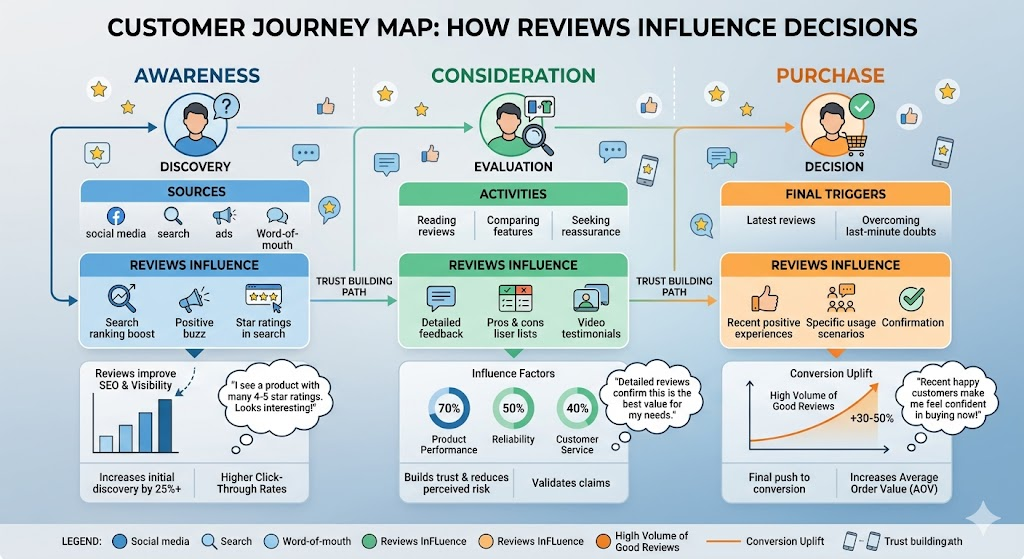
Reviews play a critical role in the early stages of the customer journey. They often appear in search results, product listings, and social platforms. This visibility helps attract potential customers before they even visit your site.
Positive reviews can act as a magnet, drawing attention to your brand. They signal quality and reliability, making users more likely to click and explore further. This gives reviews a strong advantage over discounts, which are usually only visible on-site.
To see how reviews drive awareness:
During the consideration phase, reviews become even more influential. Customers compare options, read feedback, and evaluate whether a product meets their needs. This is where detailed reviews can make or break a sale.
Unlike discounts, which simply lower the price, reviews provide context and clarity. They answer questions, address concerns, and highlight real use cases. This makes the decision process smoother and more confident.
Reviews not only help customers make better decisions, but also speed up the entire buying process. By leveraging strong social proof, businesses can shorten the sales funnel with reviews, reducing hesitation and moving customers from consideration to purchase more quickly.
Here’s how reviews impact decision-making:
The impact of reviews doesn’t end after the purchase. They also play a role in shaping customer satisfaction and loyalty. Encouraging customers to leave reviews creates a feedback loop that strengthens relationships.
When customers feel heard, they are more likely to return and recommend the brand. This creates a cycle of engagement that discounts alone cannot achieve. Over time, this leads to a more loyal customer base.
Key benefits in the post-purchase stage include:
In an era of information overload, authenticity stands out. Reviews provide unfiltered insights into customer experiences, making brands appear more transparent. This transparency builds trust and credibility.
Discounts, while attractive, do not contribute to authenticity. In some cases, excessive discounting can even raise doubts about product quality. Reviews help counter these doubts by offering genuine perspectives.
To understand the value of authenticity:
Not all reviews are positive, and that’s okay. Negative feedback, when handled properly, can actually enhance credibility. It shows that a brand is willing to listen and improve.
Responding to reviews demonstrates accountability and customer care. This level of engagement builds trust far more effectively than offering discounts. Customers appreciate brands that are responsive and proactive.
Benefits of managing negative reviews:
In saturated markets, standing out is a challenge. Discounts are easy to replicate, making them less effective as a differentiator. Reviews, however, are unique to each brand and product.
A strong collection of positive reviews can set a brand apart. It creates a competitive edge that is difficult for others to copy. This makes reviews a powerful tool for differentiation.
Businesses that effectively leverage reviews are not just improving conversions, but also building a foundation for long-term growth. By adopting a customer-led growth strategy, brands can use real customer feedback to continuously refine their products and strengthen their market position.
To see how reviews create advantage:
Reviews can be leveraged across multiple marketing channels. From social media to email campaigns, they provide content that resonates with audiences. This extends their impact beyond product pages.
Unlike discounts, which are often limited to promotions, reviews can be reused and repurposed. This makes them a versatile asset in any marketing strategy.
Ways to use reviews in marketing:
Collecting reviews requires a proactive approach. Customers are more likely to leave feedback when the process is simple and timely. This is where automation and strategy come into play.
Businesses need to create a seamless experience for review collection. This includes choosing the right channels and timing. A well-designed system ensures consistent and valuable feedback.
Best practices for collecting reviews:
Collecting reviews is only the first step. The real value comes from analyzing and acting on the feedback. This helps businesses improve products and customer experience.
Insights from reviews can guide decision-making. They reveal patterns, highlight issues, and uncover opportunities. This makes reviews a valuable source of business intelligence.
To maximize the value of reviews:

Managing reviews manually can be challenging, especially as your business grows. Tools like the Ryviu review app simplify this process by automating collection and management. This allows businesses to focus on strategy rather than logistics.
Ryviu integrates seamlessly with eCommerce platforms, making it easy to request and display reviews. It supports both email and SMS channels, ensuring maximum reach. This helps businesses build a strong and consistent flow of customer feedback.
Key features that make tools like Ryviu valuable include:
While discounts can drive short-term sales, they are not a sustainable growth strategy. Reviews, on the other hand, build trust, influence decisions, and create long-term value. This makes them a more powerful and effective tool for modern businesses.
By focusing on reviews, businesses can strengthen their brand, improve customer experience, and achieve sustainable growth. The key is to integrate review collection into every stage of the customer journey.
In the end, success is not just about offering the lowest price, but about delivering the highest value and reviews are the clearest way to prove it.