 New to Shopify? Free trial, then $1/month for your first 3 months. Start free trial →
 Where is your store?
Ryviu works with both – pick yours to continue.








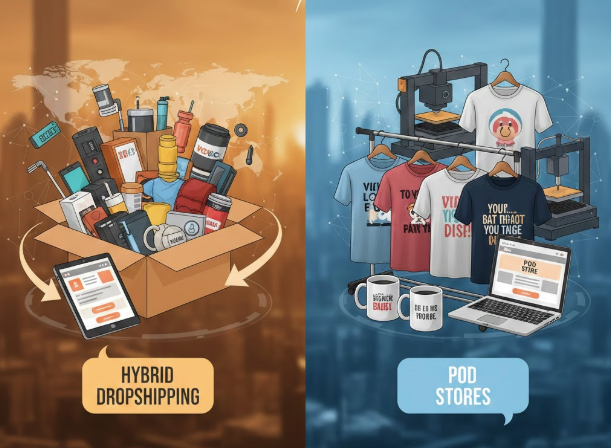
Dropshipping and print-on-demand are often presented as separate business models, each with its own strengths and limitations. Dropshipping is praised for its speed and product variety, while print-on-demand stands out for branding and customization. But as eCommerce matures, many fast-growing brands are discovering that the real advantage lies not in choosing one over the other, but in combining them.
A hybrid approach allows merchants to balance flexibility, profitability, and brand identity at scale. This article explores how hybrid dropshipping and POD stores complement each other, and why together they create a more resilient, scalable eCommerce strategy.
Before exploring how these models work together, it’s important to understand what each does best and where each tends to struggle when used alone.
Dropshipping is built for speed and breadth. Merchants can test new products quickly, expand catalogs without inventory risk, and respond to trends almost in real time. This makes it ideal for discovering winning products and scaling traffic-driven sales.
However, dropshipping often struggles with differentiation. When multiple stores sell identical products from the same suppliers, competition quickly shifts to price and advertising efficiency.
Print-on-demand focuses on customization and brand identity. By allowing designs, personalization, and niche targeting, POD helps brands stand out and build emotional connections with customers.
The tradeoff is operational speed and cost. POD products typically have longer production times and higher unit costs, which can slow down scaling if used as the sole model.
Both dropshipping and POD can grow independently, but each faces structural limitations that become more obvious as stores scale.
Growth eventually exposes weaknesses that are manageable early on but costly later.
As dropshipping stores grow, issues such as inconsistent product quality, shipping delays, and lack of brand loyalty become harder to ignore. Customer acquisition costs rise as competitors sell similar items.
Without brand differentiation, long-term retention and lifetime value remain low.
POD-only stores often rely heavily on a limited number of hero products or collections. While branding is strong, scaling traffic profitably can be difficult due to narrower appeal and higher production costs.
Growth requires careful balance between creativity and operational efficiency.
A hybrid model blends traditional dropshipping with print-on-demand products in a single store. This allows each model to cover the other’s weaknesses.
Instead of competing, the two approaches reinforce each other.
In a hybrid store, dropshipping products often serve as traffic drivers and trend testers. POD products act as brand anchors, offering exclusivity and higher perceived value.
This structure creates a layered product ecosystem rather than a one-dimensional catalog.
Hybrid stores can adapt faster to market changes. When trends shift, dropshipping allows rapid experimentation. When a niche proves profitable, POD products deepen the brand’s presence.
Flexibility becomes a strategic advantage rather than a logistical challenge.
One of the most powerful aspects of the hybrid model is using dropshipping as a testing ground for print-on-demand ideas.
Data-driven decisions reduce creative and financial risk.
Dropshipping products reveal which audiences convert, which themes resonate, and which price points perform best. This information guides POD design decisions.
Instead of guessing, brands create designs backed by proven demand.
Once a dropshipping product gains traction, it can inspire POD variations such as custom designs, slogans, or personalized versions.
This transition transforms generic products into branded experiences.
While dropshipping drives volume, POD builds identity. Hybrid stores benefit from having both transactional and emotional offerings.
Brand depth becomes a growth multiplier.
POD products allow customers to express identity, values, or belonging. This emotional layer increases attachment and repeat purchases.
Dropshipping alone rarely achieves this level of engagement.
Custom-designed products signal originality and intent. They show customers that the brand is more than a reseller.
This perception supports long-term trust and loyalty.
A hybrid approach enables smarter margin management by balancing different cost structures.
Profitability becomes more predictable across growth stages.
Dropshipping products often have lower upfront costs and faster turnover. They support consistent cash flow and fund marketing efforts.
This stability reduces pressure on POD margins.
POD products can command higher prices due to customization and exclusivity. Even with higher production costs, margins can remain attractive.
Together, the mix smooths revenue and profit fluctuations.
Hybrid stores are better positioned to increase customer lifetime value by offering variety without losing brand coherence.
Customers have more reasons to return.
Dropshipping products introduce customers to the brand, while POD products deepen the relationship. Cross-selling between the two increases average order value.
Each model supports the other in the customer journey.
POD collections evolve over time, encouraging repeat visits. Dropshipping products provide practical or trend-based reasons to buy again.
Together, they create ongoing engagement.
Operational complexity is a common concern, but modern tools make hybrid management increasingly accessible.
Systems and processes matter more than model choice.
Hybrid stores require clear workflows for handling different fulfillment timelines. Transparency in order tracking and communication is essential.
When managed well, customers experience the store as seamless, not fragmented.
Clear messaging around shipping times and product types prevents confusion. Support teams should understand the differences between dropshipping and POD orders.
Consistency in communication protects customer satisfaction.
Hybrid stores unlock marketing strategies that are difficult to execute with a single model.
Content and advertising become more versatile.
POD products enable storytelling around themes, seasons, or values. This content-driven approach strengthens brand presence on social and email channels.
Dropshipping products benefit from the increased brand trust this creates.
Dropshipping products often perform well in paid ads due to broad appeal and competitive pricing. They attract new audiences efficiently.
Once customers enter the ecosystem, POD products help retain them.
The ultimate advantage of hybrid stores lies in long-term resilience. Markets shift, platforms change, and consumer behavior evolves.
Hybrid models adapt more easily.
Relying on one model exposes brands to sudden disruptions. Supplier issues, platform changes, or trend fatigue can stall growth.
A hybrid approach spreads risk and increases stability.
As brands mature, they often move away from purely transactional models. POD supports this evolution without abandoning the efficiency of dropshipping.
Growth becomes sustainable rather than reactive.
Hybrid dropshipping and print-on-demand stores scale better together because they balance speed with substance. Dropshipping provides flexibility, testing power, and cash flow, while POD delivers branding, differentiation, and emotional connection. When combined thoughtfully, they form a system that adapts to market changes, improves profitability, and strengthens customer relationships.
Instead of choosing between efficiency and identity, hybrid stores embrace both. For modern eCommerce brands aiming to grow beyond short-term wins, this combination offers a smarter, more resilient path to scale.




