New to Shopify? Free trial, then $1/month for your first 3 months. Start free trial →
 Where is your store?
Ryviu works with both – pick yours to continue.








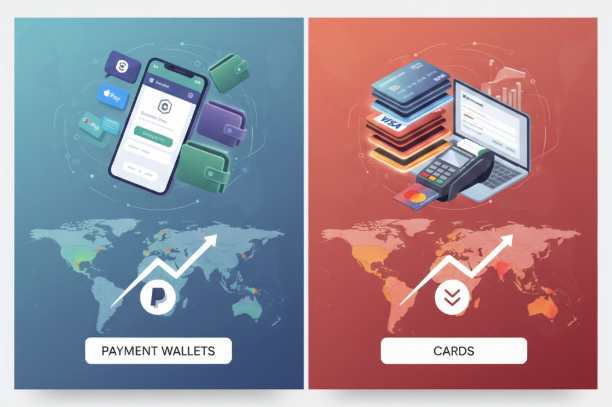
Payment choice is no longer a simple checkout detail—it is a major conversion lever. As eCommerce expands globally, merchants quickly discover that the “best” payment method depends heavily on where customers live, how they shop, and what they trust. In some regions, digital wallets feel faster and safer than cards, while in others, credit and debit cards remain the default. Understanding these regional differences is essential for reducing friction and increasing completed checkouts.
This article explores how payment wallets and cards perform across major regions, why conversion rates differ, and how merchants can optimize payment strategies for global growth.
Before comparing performance by region, it’s important to clarify what distinguishes payment wallets from traditional card payments and why shoppers perceive them differently.
Payment wallets store card details, bank accounts, or balances in a digital interface that enables one-click or biometric checkout. For consumers, wallets often signal speed, convenience, and security.
Because wallets reduce manual data entry, they feel modern and effortless, especially on mobile devices.
Credit and debit cards are deeply embedded in global commerce infrastructure. They are widely accepted, familiar, and often tied to rewards, chargebacks, and consumer protections.
In many regions, cards remain the baseline against which all other payment methods are judged.
Conversion is shaped by trust, familiarity, and ease of use. Payment methods sit at the intersection of all three.
Even small differences at checkout can have an outsized impact on completion rates.
Wallets reduce friction by shortening the checkout process. Cards, while more manual, often inspire confidence due to long-standing usage and clear dispute mechanisms.
Which factor matters more depends on local shopping habits and digital maturity.
Mobile-first markets tend to favor wallets, while desktop-heavy regions often see stronger card performance. The device mix of a region directly affects which payment method converts better.
Understanding this relationship helps explain regional variation.
In North America, credit and debit cards remain the most widely used online payment method, but wallets are gaining ground.
Consumer behavior here reflects both habit and infrastructure maturity.
Cards are deeply integrated into financial life, offering rewards, credit lines, and buyer protection. Many consumers trust cards implicitly and feel comfortable entering card details online.
This familiarity keeps card conversion rates high, especially on desktop checkouts.
On mobile devices, wallets often convert better due to speed and biometric authentication. Younger shoppers and frequent mobile buyers increasingly prefer wallets for everyday purchases.
As mobile commerce grows, wallets continue to close the conversion gap.
Europe presents one of the most diverse payment environments in the world. Conversion performance varies significantly by country.
Local preferences matter more here than continent-wide trends.
In countries like the UK, France, and Germany, cards still perform well, but wallets are widely accepted and trusted. Many consumers switch seamlessly between the two.
Wallets often outperform cards in mobile checkouts, while cards remain strong on desktop.
Some European consumers favor bank-based or regional payment solutions. In these contexts, both cards and global wallets may underperform if local options are missing.
Conversion depends less on the wallet-versus-card debate and more on localization.
Asia-Pacific is the strongest region for payment wallets, driven by mobile-first behavior and rapid fintech adoption.
Here, wallets often outperform cards by a wide margin.
Many consumers skipped traditional card usage and moved directly to wallets. Mobile payments are embedded in daily life, from retail to transportation.
As a result, wallets feel more natural and trustworthy than cards.
Cards are still relevant for international purchases, high-value items, and travel-related spending. However, for everyday eCommerce, wallets usually convert better.
Merchants targeting this region benefit significantly from wallet-first checkout designs.
In Latin America, payment preferences are shaped by financial inclusion levels and trust in online payments.
Both wallets and cards face unique challenges.
Credit card penetration is lower in many Latin American countries, and concerns about fraud remain common. These factors can reduce card conversion rates.
Debit cards are widely used but may have restrictions on online transactions.
Wallets that integrate local payment methods and installment options often convert better than cards. They address trust concerns and offer alternatives to traditional credit.
As fintech adoption grows, wallets continue to gain traction.
The Middle East and Africa encompass diverse markets at different stages of digital payment adoption.
Conversion performance varies widely by country.
In many markets, cards are still the primary online payment method, especially for international eCommerce. They provide a familiar framework for online purchases.
Where card infrastructure is strong, cards tend to convert reliably.
In mobile-heavy and younger demographics, wallets are becoming increasingly popular. They simplify payments and reduce dependence on traditional banking.
In these segments, wallets often show higher conversion rates than cards.
Beyond technology, trust and regulation play a critical role in payment conversion.
Consumers choose what feels safest within their local context.
Regions with strong consumer protection laws often see higher card usage, as buyers feel protected against fraud or disputes.
In markets where such protections are weaker, wallets may be perceived as safer intermediaries.
Well-known wallet brands benefit from existing trust. When consumers already use a wallet daily, they are more likely to complete a purchase using it.
This familiarity directly boosts conversion rates.
Payment method availability alone is not enough. How options are presented significantly affects conversion.
Design choices can amplify or undermine regional preferences.
Displaying the most popular local payment method first reduces cognitive load. When shoppers immediately see their preferred option, they are more likely to complete checkout.
Poor prioritization can suppress conversion even when the right methods are available.
Offering too many payment options can create hesitation. A focused set of regionally relevant methods performs better than a long, generic list.
Simplicity supports confidence.
Merchants should rely on performance data rather than assumptions when deciding between wallets and cards.
Behavior often differs from expectations.
Tracking conversion rates, abandonment, and average order value by payment method reveals which options truly perform best.
These insights enable continuous optimization.
A/B testing payment order, defaults, and messaging helps fine-tune checkout performance. Small changes can produce meaningful gains.
Regional testing is especially important for global stores.
There is no universal winner between wallets and cards. The best strategy adapts to regional behavior.
Flexibility and localization are key.
In most regions, offering both wallets and cards maximizes reach. Leading with the most relevant option improves conversion.
The goal is not choice, but comfort.
Early-stage stores may prioritize simplicity, while scaling brands benefit from deeper localization. Payment strategy should evolve with market expansion.
Conversion optimization is an ongoing process, not a one-time setup.
Payment wallets and cards each convert better in different regions because they align with local habits, trust levels, and device usage. Cards remain strong in markets with mature financial infrastructure, while wallets dominate in mobile-first and rapidly digitizing regions. For global merchants, the real advantage lies in understanding these differences and designing checkout experiences that feel familiar and effortless to local customers.
By prioritizing relevant payment methods, testing continuously, and adapting by region, brands can reduce friction, build trust, and turn more visitors into satisfied customers—no matter where they shop.