 New to Shopify? Free trial, then $1/month for your first 3 months. Start free trial →
 Where is your store?
Ryviu works with both – pick yours to continue.








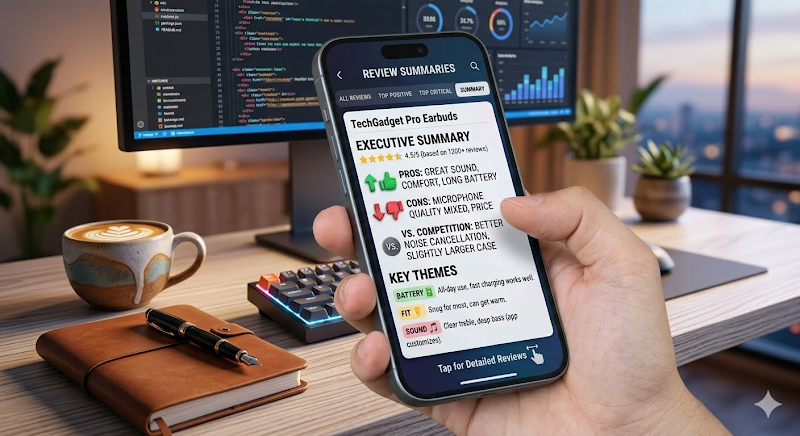
Mobile users scroll fast, skim aggressively, and make decisions in seconds. Long-form reviews still matter for depth and SEO, but they often fail to convert when attention spans are short and screen space is limited. That’s why “review summaries” have become essentially condensed, scannable, and optimized for quick decision-making.
In this guide, you’ll learn how to create effective review summaries tailored for mobile users, structure them for clarity, and integrate them seamlessly into your product pages. You’ll also see how tools like the Ryviu review app can support this process without overwhelming your workflow.
Mobile commerce has reshaped how customers interact with product content. Instead of reading everything, users jump between highlights, looking for quick validation before buying. Review summaries bridge the gap between detailed feedback and instant understanding. They reduce cognitive load while preserving trust, making it easier for customers to feel confident in their decisions. By highlighting real customer experiences, summaries tap into social proof, influencing customer decision-making and encouraging faster conversions. When done right, they increase engagement, reduce bounce rates, and improve conversion rates.
To understand how to make them effective, let’s break down the key benefits of review summaries for mobile-first experiences:
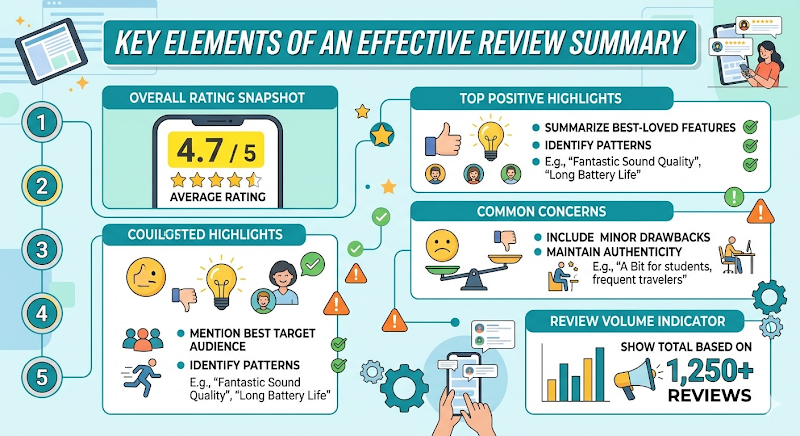
A strong review summary isn’t just shorter, it’s smarter. It extracts the most valuable insights and presents them in a way that aligns with how users consume information on mobile devices. Instead of copying full reviews, you need to identify patterns, highlight consensus, and structure the content visually. This ensures users can instantly understand both the strengths and weaknesses of a product.
To build high-performing summaries, focus on including these essential elements:
Mobile screens demand simplicity and clarity. Dense paragraphs discourage reading, while structured formats guide the user’s eyes naturally through the content. The goal is to make your summaries feel effortless to consume. This means using spacing, icons, and short text blocks to create a visually digestible layout.
To optimize structure for mobile, apply these formatting principles:
Raw customer reviews are rich with information, but they’re often repetitive and unstructured. The challenge is to transform this data into meaningful insights without losing authenticity. This process involves identifying recurring themes and filtering out noise. These summaries help structure feedback in a way that supports customer reviews SEO, making it easier for search engines to understand user intent. By doing so, you create summaries that reflect real customer sentiment rather than isolated opinions.
Here’s how to extract actionable insights from reviews effectively:

Conciseness doesn’t mean losing persuasion, it means delivering impact with fewer words.Every sentence in your summary should serve a purpose and guide the user toward a decision. Strong wording helps users quickly understand why a product is worth considering. At the same time, it should remain neutral enough to feel trustworthy.
To write effective summary copy, follow these guidelines:
Visual elements play a huge role in mobile engagement. A well-designed summary can communicate more in a glance than a block of text ever could. By combining text with visuals, you create a more dynamic and user-friendly experience. This not only improves readability but also increases the likelihood that users will interact with the content.
To enhance your summaries visually, consider these design techniques:
Not all customers are the same, and a one-size-fits-all summary may not resonate with everyone. Personalization helps users see how a product fits their specific needs. By tailoring summaries to different segments, you make them more relevant and persuasive. This is especially important for products with diverse use cases.
To personalize effectively, you can:
Even the best summary won’t work if it’s placed in the wrong spot. Positioning is critical to ensuring users actually see and use the information. Review summaries should appear where users naturally look during their decision-making process. This increases their impact and supports a smoother buying journey.
To integrate summaries effectively, follow these placement strategies:
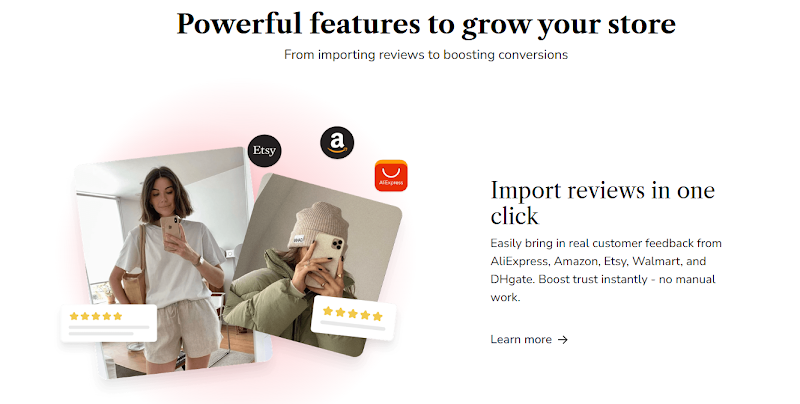
Manually creating summaries can be time-consuming, especially for stores with a large volume of reviews. Automation tools help streamline this process while maintaining consistency. With the right tool, you can collect, organize, and display reviews in a structured way that supports summary creation. This allows you to focus more on optimization rather than data collection.
Tools like the Ryviu review app can assist by:
While review summaries are powerful, they can backfire if implemented poorly. Over-simplification or bias can reduce trust instead of building it. It’s important to strike the right balance between brevity and accuracy. This ensures your summaries remain both useful and credible.
To avoid common pitfalls, keep these points in mind:
Creating summaries is only the first step, you also need to measure their effectiveness. Data helps you understand what works and where improvements are needed. By tracking performance, you can refine your approach and maximize results over time. This turns review summaries into a continuously improving asset.
To evaluate impact, monitor these metrics:
Review summaries are no longer optional, they’re a necessity in a mobile-first world. They help users quickly understand products, build trust, and make confident purchasing decisions without friction. By focusing on clarity, structure, and relevance, you can transform raw reviews into powerful conversion tools. When combined with supportive platforms like the Ryviu review app, the process becomes more efficient and scalable.
Ultimately, the goal is simple: make it easier for fast-scrolling users to say “yes” with confidence.




