New to Shopify? Free trial, then $1/month for your first 3 months. Start free trial →
 Where is your store?
Ryviu works with both – pick yours to continue.








Customer reviews are no longer just a “nice-to-have” element in digital commerce; they shape trust, influence buying decisions, and provide actionable insights for improvement. However, not all products operate under the same customer lifecycle, which means review systems must be designed differently depending on whether the product is subscription-based or purchased once. Understanding these differences is critical for building a review system that captures meaningful feedback and drives long-term value.
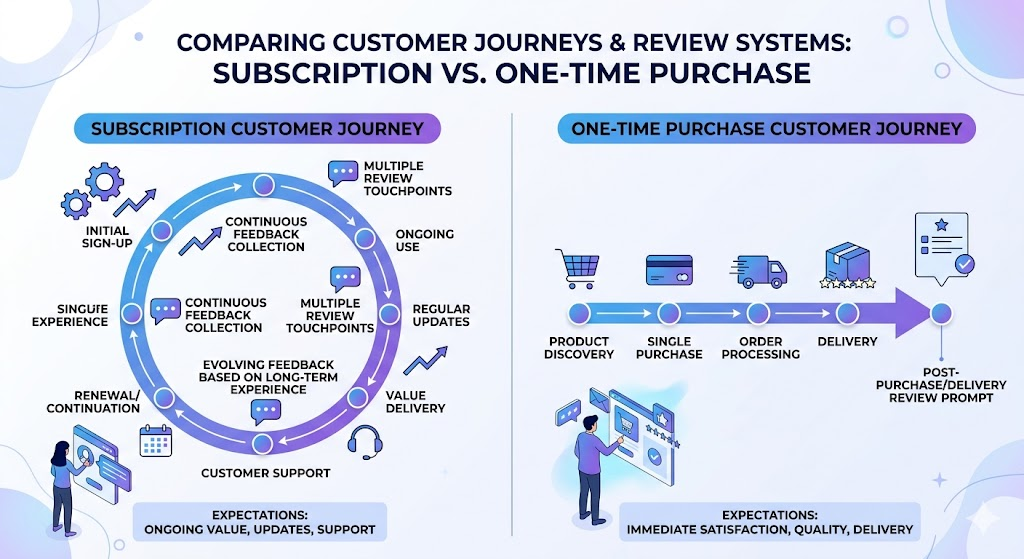
While one-time products focus on immediate satisfaction, subscription products require continuous engagement and evolving feedback loops. This distinction changes when, how, and why reviews should be collected. To build an effective system, businesses must align review strategies with the nature of their product model.
Before designing a review system, it’s important to understand the behavioral differences between customers of subscription services and one-time purchases. Subscription users interact with a product repeatedly over time, while one-time buyers typically engage once or occasionally. These usage patterns directly influence the timing and depth of feedback. Businesses today often sell across multiple platforms, making it increasingly important to collect product reviews from marketplaces to ensure consistent and reliable customer feedback across channels.
The expectations also differ significantly between the two models. Subscription customers expect ongoing value, updates, and support, whereas one-time buyers often evaluate based on a single experience. These contrasting expectations shape how review systems should be structured.
To translate these insights into actionable system design elements, consider the following distinctions:

Subscription-based products thrive on long-term relationships, making continuous feedback essential. Instead of a single review request, businesses should implement recurring opportunities for users to share their experiences. This allows companies to track sentiment changes over time and identify churn risks early.
A well-designed system captures feedback at multiple stages, such as onboarding, mid-usage, and renewal points. This ensures a more complete understanding of the customer journey rather than relying on a single snapshot. Over time, this creates a rich dataset that reflects evolving user needs.
To effectively implement continuous feedback loops, consider the following:
Unlike one-time purchases, subscription products benefit from lifecycle-based review prompts. Each stage of the customer journey offers unique insights, from first impressions to long-term satisfaction. Designing review triggers around these stages ensures more relevant and contextual feedback.
For example, early-stage reviews might focus on onboarding experience, while later reviews can assess product value and retention factors. This layered approach provides a more comprehensive understanding of customer sentiment. It also helps identify specific friction points within the lifecycle.
To structure lifecycle-based triggers effectively, focus on the following:
Subscription customers may hesitate to leave repeated feedback unless the process feels effortless and meaningful. Therefore, the review system must reduce friction and emphasize the value of user input. Transparency about how feedback is used can significantly increase participation.
Creating a feedback culture where users feel heard encourages ongoing engagement. This can be achieved through personalized prompts and visible improvements based on feedback. Over time, this builds trust and strengthens customer relationships.
To foster continuous engagement, consider:

For one-time products, timing is everything when it comes to collecting reviews. Asking too early may result in incomplete feedback, while asking too late may reduce response rates. The ideal moment is shortly after the customer has fully experienced the product. Timing becomes even more critical when dealing with limited inventory or campaigns, which is why brands should understand how to manage reviews for seasonal products effectively to capture timely and relevant feedback.
This timing ensures that feedback is both fresh and informed. It also increases the likelihood of capturing detailed insights about product quality and delivery experience. A well-timed review request can significantly improve response rates.
To optimize post-purchase timing, focus on:
One-time buyers are less likely to engage in lengthy review processes. Therefore, simplicity is key to increasing participation. The review system should be intuitive, quick, and accessible across devices.
Reducing friction in the review process leads to higher completion rates and more authentic feedback. Even small design improvements, such as fewer fields or clear instructions, can make a significant difference. The goal is to make reviewing feel effortless rather than burdensome.
To simplify the process, consider:
For one-time products, reviews serve as critical social proof for future buyers. Displaying reviews prominently on product pages can significantly influence purchasing decisions. In many cases, customer testimonials can be even more effective in building trust and guiding buying decisions. This makes the quality and presentation of reviews just as important as their collection.
A well-structured system ensures that reviews are easy to read, filter, and trust. Verified purchase labels and detailed feedback enhance credibility. This not only improves conversion rates but also builds brand trust.
To maximize the impact of social proof, focus on:
While both subscription and one-time product reviews provide valuable insights, the way this data is used differs significantly. Subscription models rely on longitudinal data to identify trends and predict churn. In contrast, one-time product reviews are often used to optimize product quality and marketing strategies.
Understanding these differences helps businesses extract maximum value from their review systems. It also ensures that feedback is not just collected but actively used to drive improvements. Many businesses fail to close the feedback loop at this stage.
To effectively utilize review data, consider:
Some businesses operate in both subscription and one-time models, requiring a hybrid approach to review systems. In such cases, flexibility becomes essential. The system must adapt to different customer journeys while maintaining consistency in data collection.
A hybrid strategy allows businesses to capture both immediate and long-term feedback. This provides a more holistic view of customer experience across different product types. It also ensures that no valuable insights are missed.
To implement a hybrid strategy effectively, focus on:
Designing an effective review system can be complex, especially when managing multiple product types. This is where specialized tools can make a significant difference. The right platform simplifies review collection, organization, and analysis.
A tool like the Ryviu review app helps businesses streamline the entire review process. It supports automated review requests, customizable display options, and integration with eCommerce platforms. This makes it easier to implement both subscription and one-time review strategies without additional complexity.
To enhance your review system with tools, consider:
Regardless of the product type, certain best practices apply to all review systems. These principles ensure that feedback is authentic, actionable, and beneficial for both businesses and customers. Following these guidelines can significantly improve the effectiveness of your review strategy.
A well-designed system not only collects reviews but also enhances the overall customer experience. It builds trust, encourages engagement, and drives continuous improvement. Ultimately, this leads to better products and stronger customer relationships.
To follow best practices, focus on:
Designing review systems for subscription and one-time products requires a deep understanding of customer behavior and expectations. While subscription models benefit from continuous, lifecycle-based feedback, one-time products rely on timely and simplified review collection. Recognizing these differences is essential for building a system that delivers meaningful insights.
By aligning review strategies with product types, businesses can capture more relevant feedback and improve customer experiences. Leveraging tools like the Ryviu review app further simplifies this process, enabling efficient management and analysis of reviews. In the end, a well-designed review system becomes a powerful asset for growth, trust, and long-term success.