New to Shopify? Free trial, then $1/month for your first 3 months. Start free trial →
 Where is your store?
Ryviu works with both – pick yours to continue.








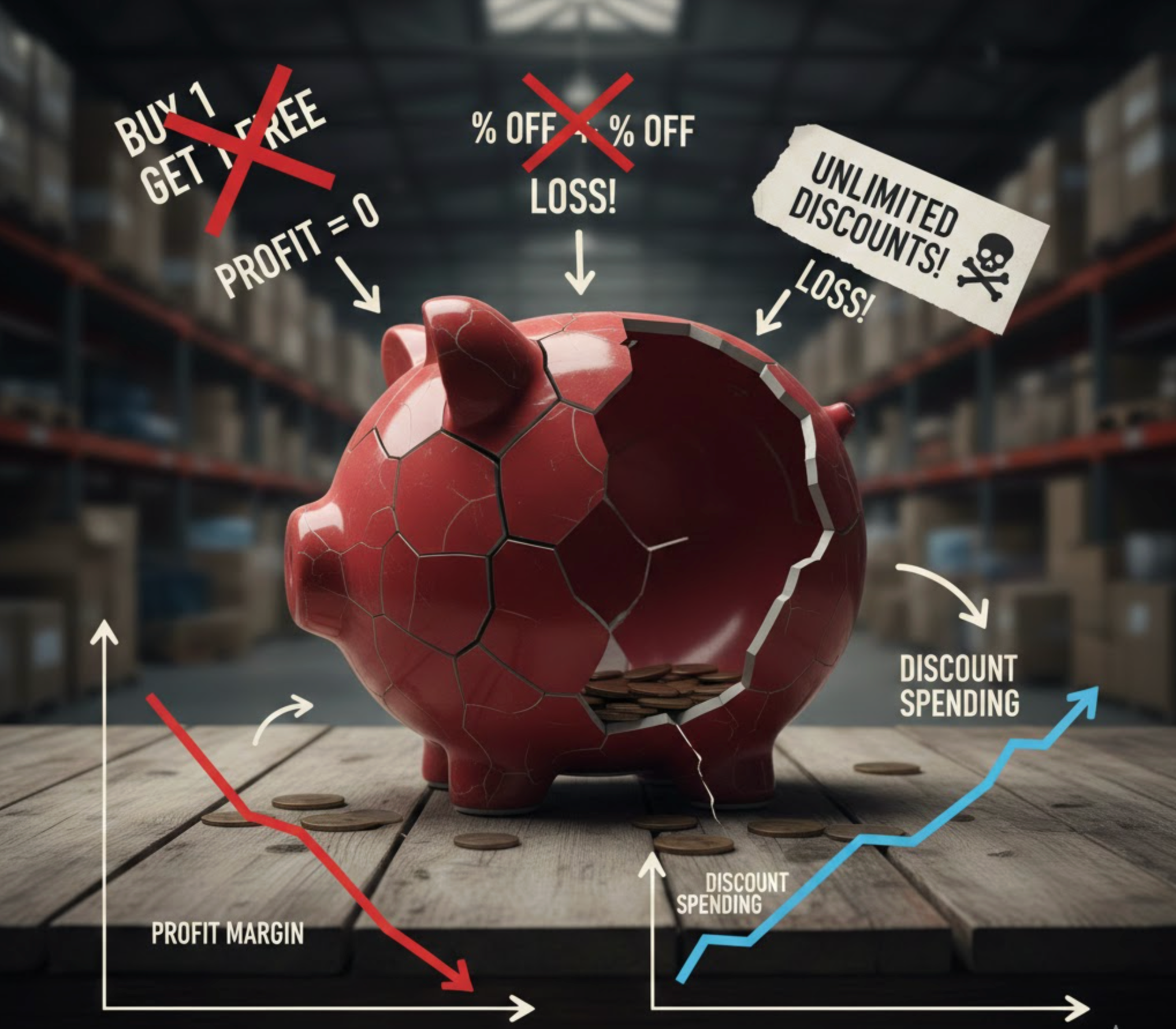
Discounts can drive quick wins, more clicks, more carts, and more conversions. But as many merchants eventually discover, discounting is a double-edged sword. While it can attract buyers and boost sales, it can also quietly chip away at your profit margin if not handled with intention. This is why understanding how and when to discount is just as important as deciding how much to discount. When discount rules are poorly planned or blindly applied, they can shift your entire pricing structure in a way that harms your long-term revenue.
To help you avoid these pitfalls, let’s walk through the most common discount rule mistakes that quietly damage your margins. As you’ll see, each mistake often connects to another, so creating a smooth, strategic discount framework is essential for keeping your profitability intact.

Many merchants start discounting more often when they notice dips in sales. At first, this feels like a reliable tactic, after all, discounts usually create a surge in orders. But as time goes on, customers begin to recognize the pattern. Once they realize discounts appear regularly, they naturally wait for the next one instead of buying right away.
Why this kills margins:
Better approach:
Instead of offering promotions on impulse, keep them tied to intentional events. By spacing out your offers and communicating them purposefully, you help customers understand your pricing integrity while still benefiting from strategic sales boosts.
It’s surprisingly easy to choose discount numbers based on what “sounds good.” But without calculating your actual margins, you might unintentionally give away more profit than you intended. A discount that looks modest in theory can turn into a margin killer once product costs, shipping, and marketing expenses enter the equation.
Why this kills margins:
Better approach:
A margin-first mindset keeps your discount strategy grounded. Before launching any rule, start by calculating your minimum acceptable profit per item. From there, work backward to see what discount level still keeps you comfortably above your break-even point.

As your catalog evolves, certain products naturally outperform others. These items often convert well without needing incentives. However, when merchants run sitewide discounts, these best sellers get discounted alongside everything else, even though they never needed help to sell in the first place.
Why this kills margins:
Better approach:
To keep your pricing strategy balanced, make sure your best sellers or high-demand items are excluded from broad discount rules. This way, you protect your strongest revenue drivers while using targeted discounts on categories that truly need them.
Discount stacking is one of the most harmful and easily overlooked issues in Shopify stores. Because discount types come from different sources, Shopify, apps, and manual codes, they can overlap if not carefully managed. Customers may accidentally (or intentionally) combine promotions for much larger discounts than intended.
Why this kills margins:
Better approach:
A thorough testing process prevents unintentional stacking. Make it a habit to test different discount combinations before going live. Additionally, use tools that allow you to control which discounts override or disable others, ensuring they function exactly as intended.
A strong welcome discount can attract new shoppers, but without clear structure, it becomes a margin trap. If customers can apply their first-time discount to any product without limits, many will simply choose your cheapest item and never return. This means you’re spending acquisition dollars on customers who provide almost no return value.
Why this kills margins:
Better approach:
To turn first-time discounts into profitable incentives, pair them with minimum purchase amounts or restrict them to specific collections. This steers customers toward meaningful purchases rather than letting them “cherry-pick” low-value items.
When sales slow down, it’s tempting to run a massive storewide discount to boost activity. However, discounts don’t magically create purchase intent. If shoppers weren’t ready to buy before, a discount often won’t change their behavior, and you’ll end up discounting purchases from people who would have bought anyway.
Why this kills margins:
Better approach:
Before resorting to price cuts, focus on improving traffic quality with stronger content, better SEO, social proof, or better product presentation. Once intent is higher, a strategically timed discount becomes far more effective, and profitable.
Not every customer segment responds to discounts in the same way. When you use one broad discount rule for all visitors, you either give away too much or fail to provide enough incentive where needed. As a result, the promotion performs inefficiently and wastes margin.
Why this kills margins:
Better approach:
Segment your offers for better margin protection. Your promotions will be more strategic when tailored to specific needs, whether you're targeting first-time buyers, high-spending VIPs, cart abandoners, or bundle shoppers.
A discount rule that applies to all order values may seem generous, but it often backfires. Without minimum purchase requirements, shoppers have no pressure to increase their order size. This leads to small, low-margin purchases that barely generate profit.
Why this kills margins:
Better approach:
Introduce thresholds like “$10 off orders above $60” or “Free shipping for $75+.” These rules naturally encourage customers to add more to their cart, creating healthier and more profitable transactions.
It’s easy to assume a discount campaign is successful just because revenue increases. But revenue alone doesn’t tell the whole story. Without analyzing profit impact, you might unknowingly be running campaigns that appear successful but damage your margins significantly.
Why this kills margins:
Better approach:
Make it a routine to review not just revenue, but profit per order, AOV changes, customer lifetime value, and margin impact. These insights guide better decisions and ensure your discount strategy supports, not undermines, your financial goals.
Discounting is not the enemy of profitability, misaligned discount rules are. When merchants rely on broad or unchecked discounts, margins shrink and customer expectations shift. However, by applying discounts with strategic timing, clear thresholds, and smart segmentation, you can drive conversions without hurting long-term profitability. Ultimately, the goal is to use discounts as controlled tools that support your brand’s growth, not as a default lever that undermines your margins.