New to Shopify? Free trial, then $1/month for your first 3 months. Start free trial →
 Where is your store?
Ryviu works with both – pick yours to continue.








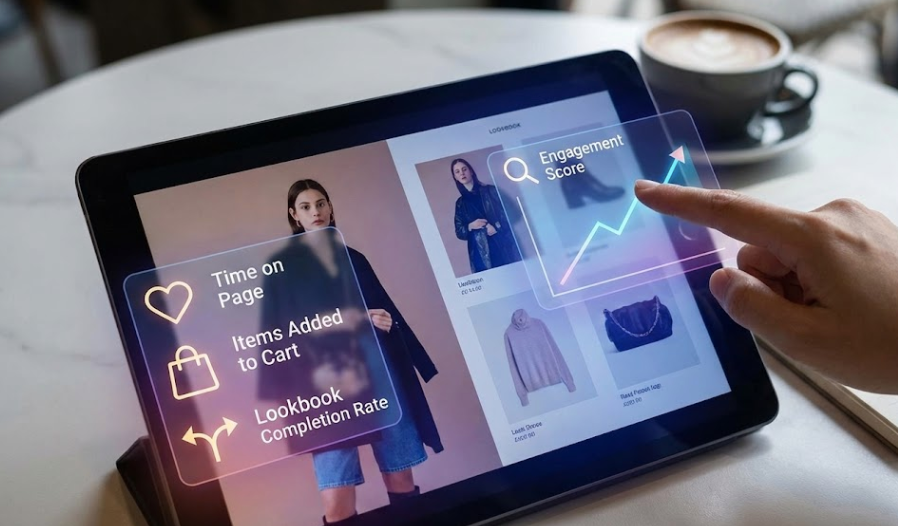
Lookbooks have become a powerful tool for modern eCommerce, especially for brands that sell visually driven products. They help customers imagine products in real-life contexts, tell a cohesive brand story, and move browsing closer to buying. Yet many businesses still evaluate lookbook performance using one shallow metric: clicks. While clicks are easy to track, they reveal very little about whether a lookbook actually influences purchase decisions.
To understand real impact, brands need to look deeper—at behavior, intent, and downstream outcomes. This article explores how to measure lookbook performance beyond clicks and how those insights can guide smarter design, merchandising, and conversion strategies.
Clicks measure interaction, not influence. A customer can click through a lookbook out of curiosity and leave without any intent to buy. Another customer may spend minutes scrolling, comparing products mentally, and return later to purchase without ever clicking directly from the lookbook.
When performance is judged only by clicks, lookbooks risk being undervalued or misinterpreted as ineffective. Their real strength often lies in shaping perception, reducing uncertainty, and supporting decisions that happen later in the journey.
At a deeper level:
Lookbooks are rarely the final conversion point. Instead, they operate in the middle of the funnel, helping customers transition from interest to confidence. They answer questions that product pages alone cannot, such as how items fit together, how they look in use, or how they reflect a lifestyle.
Measuring performance requires recognizing this role. Instead of asking “Did this lookbook convert?” the better question is “Did this lookbook move the customer closer to a decision?”
Lookbooks commonly influence:
One of the most valuable indicators of lookbook effectiveness is time spent. When users linger on a lookbook, scroll deeply, or revisit it, they’re signaling interest and cognitive engagement.
Unlike clicks, time-based metrics capture how immersive the experience is. A lookbook that keeps users engaged for several minutes is likely doing more persuasive work than one that generates quick, shallow interactions.
Key engagement signals include:
An effective lookbook encourages exploration. Customers may view products they wouldn’t have searched for directly or consider combinations they hadn’t imagined.
Instead of tracking only direct product clicks, look at what happens after exposure. Do users visit more product pages? Do they explore related categories? These behaviors suggest the lookbook is expanding consideration rather than pushing a single action.
Meaningful indicators include:
Even when lookbooks don’t drive immediate conversions, they often improve the quality of those conversions. Customers who engage with lookbooks tend to be more informed and more intentional.
This shows up in metrics like lower bounce rates on product pages, higher add-to-cart rates, and fewer abandoned checkouts later. Measuring these downstream effects reveals how lookbooks support stronger buying decisions.
Look for changes in:
Lookbooks naturally showcase products together, which subtly encourages bundling and higher spend. Customers exposed to curated sets are more likely to add complementary items rather than purchasing a single product.
Average order value often increases even if click-through rates remain flat. This makes AOV a critical metric when evaluating lookbook performance beyond surface-level engagement.
Lookbook-driven AOV impact appears through:
Assisted conversions track touchpoints that contribute to a sale without being the final interaction. Lookbooks frequently play this role, especially in longer decision cycles.
By analyzing assisted conversion paths, brands can see how often lookbooks appear earlier in successful journeys. This reframes lookbooks from “low-click content” to “high-influence content.”
Assisted conversion insights include:
Different audience segments interact with lookbooks differently. New visitors may use lookbooks for inspiration, while returning customers may use them to validate choices.
Segmenting performance by user type reveals where lookbooks are most valuable. This helps refine placement, design, and messaging to better support each audience’s needs.
Useful segmentation includes:
The impact of lookbooks doesn’t end at purchase. Customers who connect with a brand visually are more likely to return, explore future collections, and engage with new launches.
Tracking post-purchase behavior among lookbook viewers can uncover long-term value that click metrics completely miss.
Indicators of long-term impact include:
Metrics alone don’t capture emotional response. Combining analytics with qualitative feedback provides a fuller picture of lookbook performance.
Customer comments, surveys, and session recordings often reveal how lookbooks influence perception, confidence, and enjoyment. These insights guide improvements that pure data cannot.
Strong evaluation blends:
Measuring beyond clicks only matters if insights lead to action. Data should inform design changes, product selection, layout improvements, and storytelling approaches.
Over time, this creates a feedback loop where lookbooks evolve based on how customers actually use them, not how brands assume they should perform.
Effective optimization focuses on:
Measuring lookbook performance beyond clicks reveals their true value in the eCommerce journey. Lookbooks influence attention, exploration, confidence, and long-term loyalty—often without driving immediate clicks.
By focusing on engagement, assisted conversions, average order value, and post-purchase behavior, brands gain a more accurate understanding of how lookbooks contribute to growth. When measured holistically, lookbooks stop being seen as decorative content and start being recognized as strategic assets that shape how customers browse, decide, and buy.