New to Shopify? Free trial, then $1/month for your first 3 months. Start free trial →
 Where is your store?
Ryviu works with both – pick yours to continue.








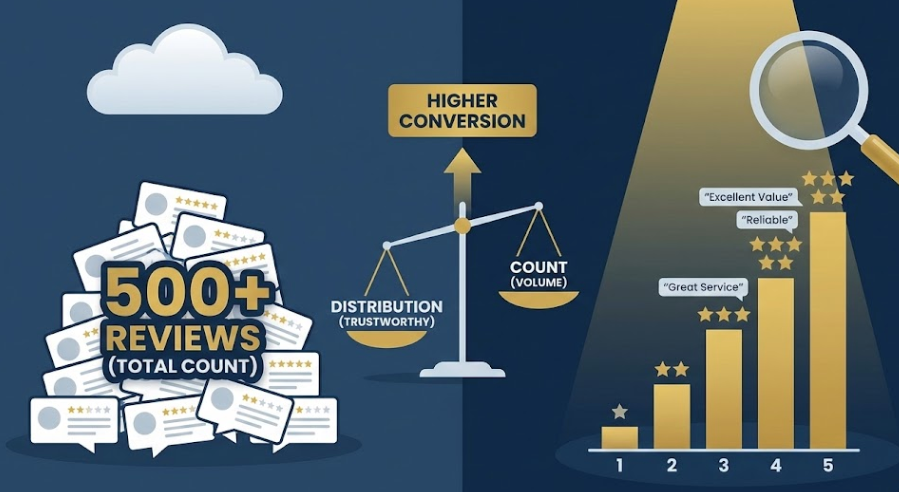
For years, online businesses have chased one metric above all others: the number of reviews. More reviews often feel like more trust, more authority, and more conversions. But as eCommerce matures, customers are becoming far more sophisticated in how they read and interpret social proof.
A product with 5,000 reviews doesn’t automatically feel more trustworthy than one with 120—especially if those reviews tell a suspiciously perfect story. What actually shapes buyer confidence today is review distribution: how ratings are spread across 1 to 5 stars and what those reviews say together. Understanding this shift is critical for brands that want to convert browsers into buyers without relying on inflated numbers.
Review count measures how many people have left feedback. Review distribution reveals how customers actually experienced the product. A store can have thousands of reviews, but if nearly all are 5-star with little variation, shoppers may question their authenticity.
Distribution shows balance. It reflects real-world experiences where no product is perfect for everyone. When customers see a healthy spread of ratings, they gain confidence that the feedback is genuine, not filtered or manipulated.
At a deeper level:
Modern shoppers don’t read reviews line by line. They scan. They look at star breakdowns, skim recent feedback, and focus on the middle ground—3- and 4-star reviews that explain trade-offs.
A product with only perfect reviews creates friction. Customers wonder what’s missing. In contrast, a product with mixed but reasonable feedback helps buyers make informed decisions, reducing uncertainty and post-purchase regret.
Behavior studies consistently show:
Humans trust stories that feel real. A perfect 5.0 rating suggests curation, while a 4.3 or 4.6 rating feels organic. Review distribution signals that feedback hasn’t been controlled or censored.
When customers see minor complaints alongside praise, they mentally prepare for those issues. This alignment between expectation and reality increases satisfaction after purchase, even if the product isn’t flawless.
From a psychological standpoint:
Counterintuitively, products with slightly lower average ratings often convert better than those with perfect scores. This happens because customers feel safer buying something they understand fully.
Conversion improves when reviews:
When distribution supports clarity, customers self-qualify. The right buyers move forward, and the wrong ones opt out—reducing refunds and negative experiences.
Middle-tier reviews are where real insight lives. They often include practical feedback, usage tips, and honest comparisons. These reviews answer questions that marketing copy avoids.
Instead of hiding these reviews, smart brands highlight them. A thoughtful 4-star review explaining a minor drawback often carries more weight than a generic 5-star compliment.
These reviews help:
Negative reviews feel risky, but they are powerful trust signals when addressed transparently. Customers don’t expect perfection—they expect accountability.
A visible, professional response to a 1- or 2-star review reassures future buyers that problems are acknowledged and resolved. Silence, on the other hand, suggests indifference.
Effective use of negative reviews includes:
Many refunds stem from expectation mismatches, not product defects. When review distribution is skewed too positively, buyers may expect perfection and feel disappointed by minor issues.
Balanced review distribution acts as pre-purchase education. Customers know what they’re getting into, which reduces frustration and return rates after delivery.
In practice:
Many eCommerce platforms and marketplaces analyze review patterns, not just counts. Suspicious distributions can trigger moderation or reduced visibility.
Search engines and recommendation systems increasingly prioritize content that appears authentic and helpful. Reviews that show nuance and depth are more likely to be surfaced than mass-produced praise.
From a visibility standpoint:
The goal of review collection shouldn’t be to chase 5-star ratings. It should be to capture real experiences. Asking open-ended questions encourages richer feedback and more natural distribution.
Timing also matters. Requesting reviews after customers have had enough time to use the product leads to more thoughtful responses than immediate post-delivery prompts.
Strong strategies focus on:
Brands that consistently display balanced reviews build long-term credibility. Customers learn that the store doesn’t hide flaws or manipulate perception.
Over time, this honesty becomes a competitive advantage. New visitors feel safer purchasing, even at higher price points, because the brand’s reputation feels earned rather than manufactured.
Long-term benefits include:
In today’s eCommerce landscape, review distribution matters more than review count because it reflects reality, not just popularity. Customers don’t want perfection—they want clarity. A balanced mix of praise, critique, and practical insight builds trust, improves conversion rates, and reduces refunds.
Instead of chasing inflated numbers, successful brands focus on encouraging honest feedback and presenting it transparently. When reviews tell a believable story, customers feel confident making decisions, and that confidence is far more valuable than any five-star total.