New to Shopify? Free trial, then $1/month for your first 3 months. Start free trial →
 Where is your store?
Ryviu works with both – pick yours to continue.








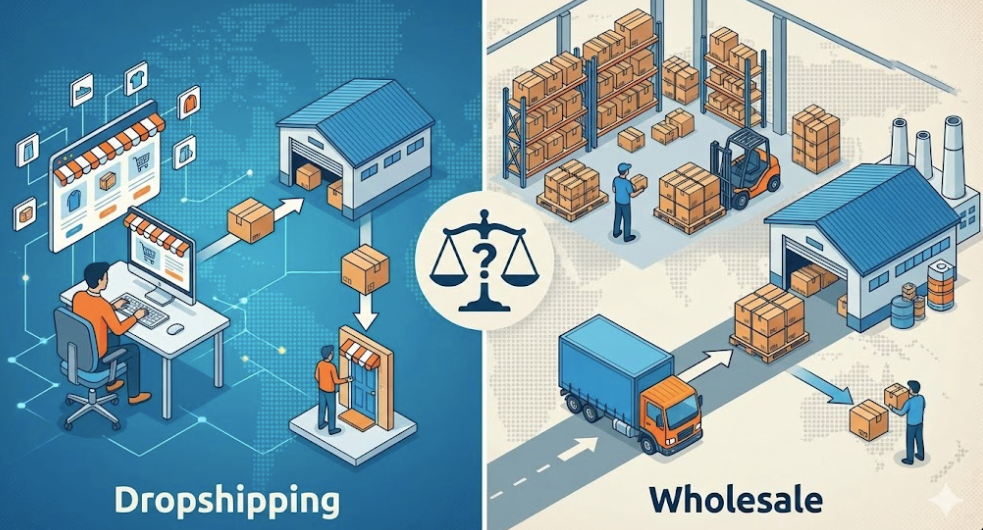
Choosing the right business model is one of the most important decisions in eCommerce. Dropshipping and wholesale are two of the most popular paths for selling products online, yet they differ fundamentally in how inventory, risk, and operations are handled.
Dropshipping attracts beginners with its low upfront costs, while wholesale appeals to sellers seeking stability and higher margins. Understanding the real trade-offs between these models goes beyond surface-level comparisons.
This guide explores dropshipping versus wholesale in depth, helping you decide which approach aligns best with your goals, resources, and long-term vision.
Dropshipping allows sellers to list products without holding inventory. When a customer places an order, the seller purchases the item from a supplier, who then ships it directly to the customer. The seller acts as an intermediary, focusing on marketing, customer service, and store management.
This model removes the need for warehousing and upfront inventory investment. However, it also limits control over fulfillment, packaging, and product quality, which directly affects the customer experience.
Dropshipping’s low barrier to entry makes it especially attractive to newcomers. Starting costs are minimal, and sellers can test products quickly without committing to large orders.
The flexibility to add or remove products easily supports experimentation, but this same flexibility can lead to inconsistent offerings and intense competition.
Wholesale involves purchasing products in bulk from manufacturers or distributors at discounted prices, then storing and reselling them at a markup. The seller owns the inventory and manages fulfillment directly or through a third-party logistics provider.
This model requires upfront capital but offers greater control over pricing, branding, and logistics. Wholesale sellers are responsible for storage, shipping, and inventory management.
Wholesale appeals to sellers who prioritize predictability and brand control. Buying in bulk reduces per-unit costs, enabling healthier margins and consistent supply.
While the initial investment is higher, wholesale often feels more like a traditional business model, with clearer processes and fewer external dependencies.
Dropshipping requires little capital to start. Expenses are typically limited to store setup, marketing, and software tools. Inventory costs occur only after a sale is made.
Wholesale, by contrast, demands upfront investment in inventory. Sellers must commit capital before validating demand, increasing financial risk but also potential reward.
Dropshipping shifts inventory risk to suppliers but introduces cash flow challenges, especially when payment processors delay payouts. Wholesale ties up capital in inventory, but revenue flows more predictably once sales stabilize.
Understanding your risk tolerance is critical when choosing between these models.
Dropshipping margins are often thin due to competition and supplier pricing. Sellers rely on volume, upsells, or branding to compensate.
Price control is limited, as suppliers may change costs or sell directly to consumers, undercutting resellers.
Wholesale typically offers higher margins due to bulk pricing. Sellers can negotiate better terms, control pricing, and implement long-term strategies.
The ability to absorb marketing costs and promotions more easily makes wholesale appealing for scaling businesses.
Dropshipping simplifies inventory management on the surface, but hidden complexities exist. Stock availability can change without notice, leading to canceled orders or delays.
Sellers must coordinate with multiple suppliers, often across different regions, increasing operational risk.
Wholesale requires active inventory management, including forecasting, storage, and replenishment. While this adds complexity, it also provides visibility and control.
Accurate inventory data supports better planning and customer satisfaction.
Dropshipping often involves longer shipping times and inconsistent packaging. Customers may receive products with unfamiliar branding or multiple shipments for a single order.
These factors can impact trust and repeat purchases, especially in competitive markets.
Wholesale sellers control fulfillment, enabling faster shipping, branded packaging, and consistent quality. This level of control supports stronger brand identity and loyalty.
Although fulfillment costs are higher, the improved experience often justifies the investment.
Dropshipping makes it difficult to build a distinctive brand. Products are often generic and widely available, limiting differentiation.
While private-label dropshipping exists, it requires additional coordination and reduces the model’s simplicity.
Wholesale supports deeper branding. Sellers can customize packaging, create exclusive bundles, and develop proprietary product lines.
This brand equity adds long-term value beyond immediate sales, making the business more defensible.
Dropshipping scales quickly in theory, as adding products requires little effort. In practice, scaling increases exposure to supplier issues, customer service challenges, and platform policies.
Growth depends heavily on marketing efficiency and operational discipline.
Wholesale scaling is slower but more stable. Expanding inventory, warehouses, or logistics requires planning and capital.
However, once systems are in place, wholesale businesses often scale with greater predictability and fewer surprises.
Dropshipping sellers are highly dependent on suppliers for fulfillment and quality. A supplier change or failure can disrupt the entire business.
Building reliable relationships is essential but not always feasible with large, overseas suppliers.
Wholesale relationships are typically more formal and stable. Long-term contracts and volume commitments foster reliability and mutual growth.
These partnerships reduce uncertainty and support consistent operations.
Your choice should reflect your priorities. Dropshipping suits those seeking low-risk entry and flexibility. Wholesale fits those aiming for brand control and sustainable growth.
Neither model is inherently better; success depends on alignment with your resources and vision.
Some businesses combine elements of both models. Starting with dropshipping to test products, then transitioning to wholesale for proven winners, balances risk and reward.
This hybrid strategy allows learning and validation before committing capital.
Dropshipping and wholesale represent two distinct approaches to building an eCommerce business. Dropshipping offers accessibility and flexibility, while wholesale provides control, stability, and stronger margins. Each model carries unique risks and opportunities, shaping everything from customer experience to long-term value.
By understanding their differences and aligning them with your goals, resources, and tolerance for risk, you can choose a path that supports sustainable growth. Ultimately, the best model is not the most popular one, but the one you can execute consistently and confidently over time.