New to Shopify? Free trial, then $1/month for your first 3 months. Start free trial →
 Where is your store?
Ryviu works with both – pick yours to continue.








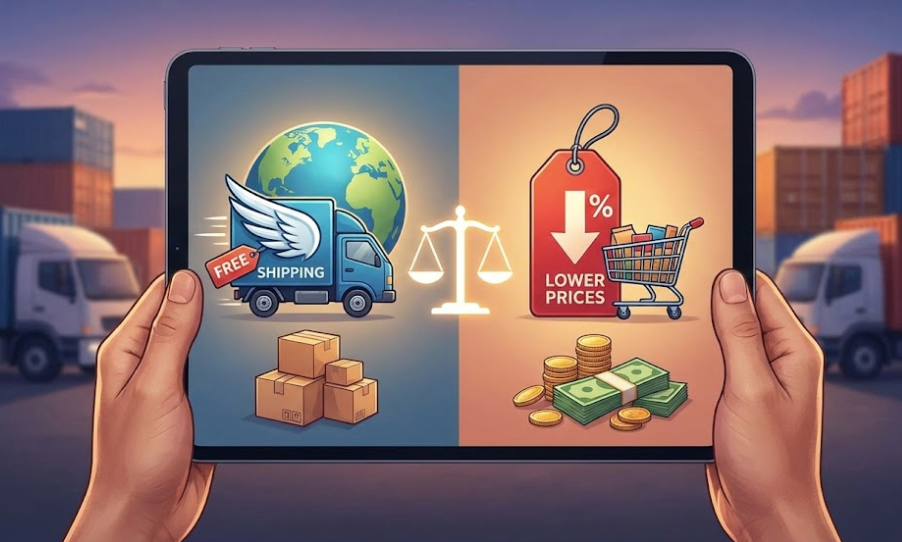
Few decisions in eCommerce generate as much debate as whether to offer free shipping or focus on lower product prices. Both strategies promise higher conversions, yet they appeal to customers in very different ways. Free shipping feels generous and frictionless, while lower prices signal value and competitiveness.
For store owners, the choice is rarely simple. Margins, customer psychology, logistics, and brand positioning all play a role. This article explores the strengths and trade-offs of free shipping versus lower prices, helping you understand how each strategy influences buyer behavior and how to choose the right approach for your business.
Free shipping is one of the most effective psychological triggers in online shopping. Customers tend to view shipping costs as a “penalty” rather than a necessary service. Even a modest shipping fee can feel disproportionate compared to the product price.
By removing that friction, free shipping simplifies the mental math of buying. The total cost feels cleaner and more predictable, which reduces hesitation at checkout.
Interestingly, customers often prefer free shipping even when the total cost is slightly higher than a lower-priced product with paid shipping. This reveals a gap between perceived value and actual savings.
Free shipping reframes the transaction as a benefit rather than a compromise, making the purchase feel like a win.
Lower prices speak directly to rational decision-making. Shoppers comparing multiple stores often focus on the visible product price before considering shipping.
In highly competitive markets, even small price differences can influence choice, especially when customers are price-sensitive or buying commoditized products.
Lower prices can also feel more honest. Some customers distrust free shipping, assuming the cost is hidden in the product price. For these buyers, a clearly lower price paired with a reasonable shipping fee feels fair and transparent.
This approach resonates strongly with experienced shoppers who compare total costs carefully.
Shipping costs are one of the leading causes of cart abandonment. Free shipping directly addresses this issue by eliminating a common point of friction at the final stage of purchase.
For many stores, introducing free shipping leads to an immediate uplift in completed checkouts, even without changing product pricing.
Free shipping lowers the psychological barrier to impulse buying. When customers feel they are avoiding an extra fee, they are more likely to complete a purchase they were already considering.
This effect is especially strong for low- to mid-priced products where shipping feels disproportionate.
Lower prices shine earlier in the buying journey. On category pages, comparison sites, or marketplaces, the product price is often the first visible differentiator.
A lower listed price can attract clicks and consideration before shipping costs are evaluated, giving you a chance to make your case through product descriptions and reviews.
Certain audiences prioritize price above all else. Students, bargain hunters, and bulk buyers may accept paid shipping if the product itself feels like a good deal.
For these segments, free shipping may be less compelling than a clear discount.
One of the most effective ways to use free shipping is through thresholds. Offering free shipping above a certain order value encourages customers to add extra items to qualify.
This strategy increases average order value while preserving margins, making free shipping a strategic tool rather than a blanket offer.
Lower prices can encourage frequent purchases, but may result in smaller baskets. Customers buy exactly what they need, especially when shipping costs are clearly stated.
This model works well for replenishable or essential products where repeat purchases matter more than order size.
Free shipping is never truly free for the seller. Shipping costs must be absorbed through pricing, margins, or operational efficiencies.
Without careful calculation, free shipping can quietly erode profitability, especially for heavy, bulky, or low-margin products.
Lower prices also pressure margins, but the impact is more visible and controllable. Shipping fees are passed directly to customers, making cost management more straightforward.
This clarity helps store owners forecast profitability more accurately.
Free shipping often signals convenience and customer-centricity. Many customers associate it with modern, premium, or service-oriented brands.
For stores positioning themselves around ease and experience, free shipping reinforces brand values and meets customer expectations.
Lower prices align with value-focused or budget-conscious brands. This approach communicates efficiency, competitiveness, and practicality.
Consistency between pricing strategy and brand identity builds trust and reduces confusion.
Free shipping tends to perform well for lightweight products, fashion, accessories, and digitally influenced shopping categories where shipping costs feel arbitrary.
In these cases, the perceived benefit often outweighs the actual cost to the business.
For large, heavy, or specialized products, shipping costs are more tangible. Customers expect to pay for delivery, and hiding these costs in pricing can feel misleading.
Lower prices with transparent shipping fees often work better in these scenarios.
The effectiveness of free shipping versus lower prices varies by audience, product, and region. What works for one store may fail for another.
Relying on assumptions rather than data leads to suboptimal decisions.
A/B testing allows you to compare strategies objectively. Testing free shipping thresholds against lower price promotions reveals how your customers actually respond.
Data from conversion rates, average order value, and profit margins provides clarity beyond intuition.
Many successful stores offer free shipping selectively, such as for VIP customers, subscription orders, or limited-time promotions.
This approach balances customer appeal with cost control.
Rather than permanently lowering prices, some stores use temporary discounts to compete while maintaining a free shipping baseline.
This flexibility allows you to adapt to market conditions without locking into thin margins.
Free shipping should be intentional, not reactive. Offering it without understanding cost implications leads to margin erosion and operational stress.
Lower prices can trigger price wars that are difficult to sustain. Competing solely on price leaves little room for differentiation or growth.
Regardless of strategy, clarity matters. Confusing pricing or hidden fees undermine trust and hurt long-term performance.
The question of free shipping versus lower prices has no one-size-fits-all answer. Free shipping excels at reducing friction, increasing conversions, and supporting a convenience-driven brand. Lower prices attract value-focused shoppers and offer clearer cost control. The best strategy depends on your products, margins, and customers’ expectations.
Often, the most effective approach blends both, using free shipping strategically while maintaining competitive pricing. By understanding the psychology, costs, and data behind each option, you can make informed decisions that support sustainable growth rather than short-term gains.