New to Shopify? Free trial, then $1/month for your first 3 months. Start free trial →
 Where is your store?
Ryviu works with both – pick yours to continue.








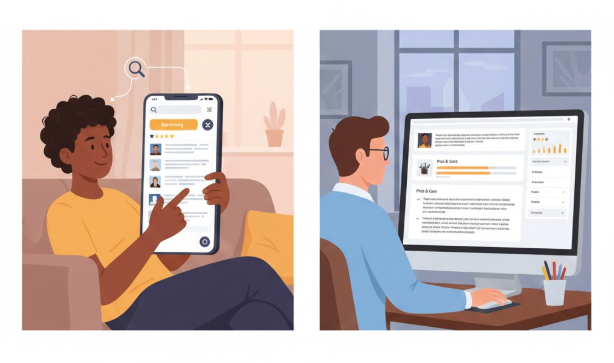
Online reviews play a central role in modern purchasing decisions, but the way customers consume and interpret reviews changes dramatically depending on the device they use. Mobile and desktop experiences shape attention spans, trust signals, and decision-making depth in very different ways. As mobile commerce continues to dominate traffic while desktop still leads in many high-consideration purchases, understanding these behavioral differences is no longer optional.
Businesses that treat reviews as a one-size-fits-all asset often miss conversion opportunities. To use reviews effectively, it is essential to understand how customers read, filter, and trust reviews on mobile versus desktop.
The device a customer uses often reflects their mindset. Mobile browsing is frequently spontaneous, fast, and context-driven, while desktop usage is more deliberate and research-oriented. This difference fundamentally changes how reviews are consumed.
On mobile, reviews act as quick reassurance. On desktop, they function as evidence.
Mobile users often shop while multitasking, commuting, or filling short breaks. Desktop users are more likely seated, focused, and ready to compare options. These environmental factors shape how deeply reviews are read and how much influence they have.
The same review content can feel persuasive on desktop but overwhelming on mobile.
Mobile users rarely read reviews in full. Small screens encourage scanning behaviors, where customers focus on highlights rather than detailed narratives.
Key mobile behaviors include:
Reviews must communicate value quickly to influence mobile shoppers.
Desktop users are more willing to read longer reviews, especially when making higher-value or more complex purchases. The larger screen reduces friction and makes extended comparison easier.
Desktop shoppers often:
On mobile, star ratings often carry more weight than written content. A high rating can immediately signal trust, allowing users to proceed without deeper investigation.
Low ratings, even with few reviews, can stop a mobile purchase instantly.
Desktop shoppers are more likely to question star ratings. They investigate review distribution, looking for patterns such as consistent complaints or recent changes.
This deeper analysis reduces the impact of superficial rating manipulation.
Mobile users are highly responsive to visual reviews. Images and short videos provide fast validation and reduce uncertainty without requiring long reading sessions.
User-generated photos often outperform text on mobile because they communicate authenticity instantly.
On desktop, images and videos are still important, but they are viewed alongside text. Users analyze visuals as part of a broader evaluation rather than as standalone proof.
This combination strengthens confidence for higher-risk purchases.
Mobile users are more influenced by visible social proof indicators, such as the number of reviews or verified buyer badges. These signals reduce friction quickly.
Trust is built through volume and immediacy rather than depth.
Desktop users tend to scrutinize credibility. They check reviewer profiles, dates, and language patterns to assess authenticity.
This behavior makes fake or low-quality reviews easier to detect on desktop.
While mobile interfaces often include filtering options, many users do not engage deeply with them. Small screens and limited patience discourage complex sorting.
Most mobile shoppers rely on default sorting or quick filters like “most recent.”
Desktop users actively filter reviews by rating, relevance, or keywords. This allows them to answer specific questions or address concerns before purchasing.
Filtering tools are significantly more impactful on desktop experiences.
Mobile shopping often occurs in emotionally charged or time-constrained moments. Reviews that express strong emotions, satisfaction, or disappointment resonate more strongly.
Short, expressive reviews can disproportionately influence mobile conversions.
Desktop users weigh emotional responses against factual details. They look for consistency across reviews and align feedback with their own use case.
Rational evaluation plays a larger role, especially for expensive or technical products.
Negative reviews have a stronger immediate impact on mobile. Even a single visible complaint can derail a purchase due to limited context and reduced patience.
Mobile users are less likely to investigate whether the issue applies to them.
Desktop users are more forgiving of negative reviews if explanations or patterns suggest isolated issues. They assess whether problems are outdated, rare, or user-specific.
This nuance reduces the fear effect of negative feedback.
On mobile, review visibility is critical. If reviews are buried too far down the page, many users will never reach them.
Strategic placement near the product title or price increases trust instantly.
Desktop layouts allow reviews to be part of a broader content hierarchy. Users are willing to scroll, click tabs, and explore sections in more detail.
This flexibility enables more comprehensive review presentation.
Concise reviews with clear outcomes perform best on mobile. Long paragraphs discourage engagement and reduce impact.
Mobile-friendly reviews often include:
Desktop users appreciate detailed stories, use cases, and comparisons. Longer reviews help answer complex questions and reduce uncertainty.
These reviews support confidence rather than impulse.
Treating reviews as static content misses their full potential. Businesses that optimize review display and structure by device see higher engagement and conversion rates.
Key strategies include:
Understanding device behavior allows brands to match reviews to intent. Mobile reviews reassure quickly, while desktop reviews educate thoroughly.
This alignment improves trust without overwhelming the user.
Customers do not use reviews the same way on mobile and desktop because their goals, environments, and attention levels differ. Mobile users seek fast reassurance through ratings, visuals, and emotional cues, while desktop users dive deeper into context, patterns, and detailed experiences.
Recognizing these differences allows businesses to design review experiences that support both quick decisions and thoughtful evaluation. When reviews are tailored to how customers actually read them, they become more than social proof—they become a powerful driver of confidence and conversion across every device.