New to Shopify? Free trial, then $1/month for your first 3 months. Start free trial →
 Where is your store?
Ryviu works with both – pick yours to continue.








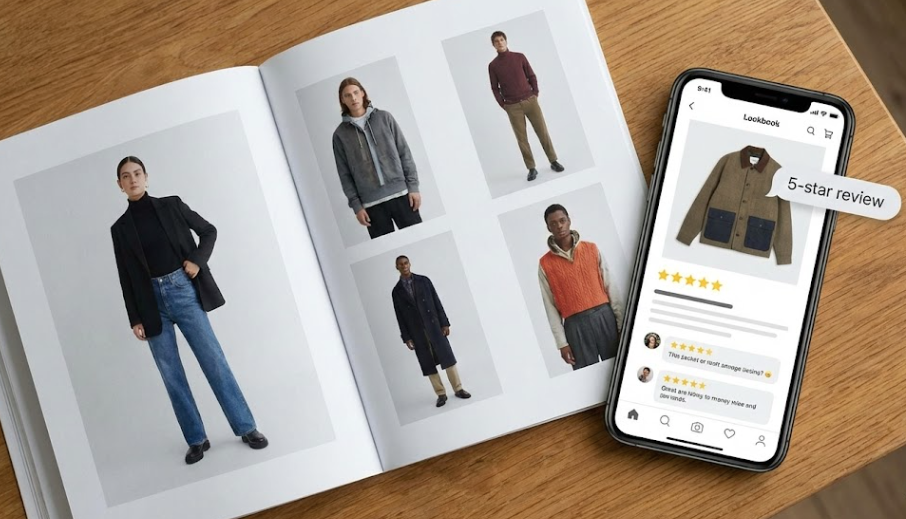
In a digital world where customers rely on both inspiration and proof before making a purchase, combining reviews and lookbooks has become one of the most powerful ways to build trust.
Each element works beautifully on its own—reviews provide credibility, while lookbooks inspire—but together they create a seamless journey that shows buyers exactly how your products look, feel, and perform in real life. This combination is especially effective for fashion, lifestyle, home décor, beauty, and print-on-demand brands that need strong visual storytelling to close the gap between expectation and reality.
This article explores how to blend reviews and lookbooks in a way that boosts conversions, increases confidence, and elevates your brand presence.
Modern eCommerce is moving away from static product listings and toward “experience-first” shopping. Customers expect authenticity, personalization, and proof. Lookbooks offer curated inspiration, but without reviews, they can feel overly polished.
Reviews offer social proof, but without lifestyle visuals, they can feel detached from the brand experience. When combined, they create a richer, more emotional story that guides the customer from desire to validation.
Buying decisions are influenced by a blend of emotional and rational triggers. Lookbooks ignite the emotional: color, mood, styling, and lifestyle. Reviews satisfy the rational: product quality, delivery experience, sizing, and practicality. When both are integrated:
This merging helps reduce doubt and speeds up decision-making.
Lookbooks traditionally showcase highly stylized visuals, but customers today prefer authenticity. Instead of relying solely on studio shots, brands now mix professional imagery with user-generated content from reviews. This creates a balanced mood—polished yet relatable. When planning a lookbook:
A story-driven lookbook feels more natural and encourages users to imagine themselves using the product.
The arrangement of photos matters. A strong sequence moves from inspiration to practicality:
This sequence reinforces the message that what buyers see is what they actually get.
Visual reviews—photos or videos uploaded by customers—are far more persuasive because they eliminate the fear of unrealistic expectations. These visuals:
As a result, visual reviews often boost conversions significantly more than written ones alone.
To maximize the impact of lookbooks, brands need a steady flow of customer visuals. You can encourage this by:
Once customers see their photos showcased, they feel like part of the brand story—motivating more submissions over time.
A modern, conversion-friendly layout doesn’t separate reviews and lookbooks; it intertwines them. Instead of placing reviews only on individual product pages, you can embed them directly inside themed lookbooks to support the storytelling. This creates a browsing experience where every photo feels supported by social validation.
For example:
The goal is to blur the line between inspiration and proof.
Beyond static images, interactive design enhances trust-building. You can integrate:
These elements guide shoppers deeper into the content without interrupting their browsing flow.
When reviews appear inside a themed lookbook, they gain more emotional weight because the context matches the message. For example:
Contextual relevance makes reviews feel more personal and believable.
Reviews often contain hidden storytelling gems—sentences that describe how the product is used in daily life. These insights can guide lookbook creation. For example:
The lookbook becomes a visual extension of what customers already love.
A powerful structure ensures customers organically move from browsing to buying. A solid flow looks like this:
Lookbook → UGC photos → Highlighted reviews → Social proof summary → Product page with full reviews
This approach reduces friction. By the time shoppers reach the product page, they’ve already absorbed enough visual and emotional reassurance to feel confident in the purchase.
Lookbooks and reviews are strong assets for retention and remarketing. Combined, they dramatically improve engagement in:
Visual social proof drives curiosity, while curated lookbooks reignite desire.
Many platforms and apps allow you to merge UGC, reviews, and lookbooks effortlessly. When evaluating tools, consider features like:
These tools help maintain visual consistency and ensure that everything loads quickly and cleanly.
A scalable workflow allows your lookbooks to refresh automatically as new reviews roll in. Automation helps by:
This keeps your visual storytelling dynamic and continuously evolving.
Combining reviews and lookbooks is one of the most effective ways to turn your store into a trustworthy, visually rich shopping experience. Reviews offer authenticity, while lookbooks ignite desire; together they bridge the gap between inspiration and proof. This powerful combination helps customers see your product in real life, trust it more deeply, and buy with confidence.
As online shoppers expect increasingly immersive and personalized experiences, integrating lookbooks with social proof isn’t just a design choice—it’s a long-term growth strategy that strengthens credibility, boosts conversions, and builds a community of engaged buyers who proudly showcase your brand.