New to Shopify? Free trial, then $1/month for your first 3 months. Start free trial →
 Where is your store?
Ryviu works with both – pick yours to continue.








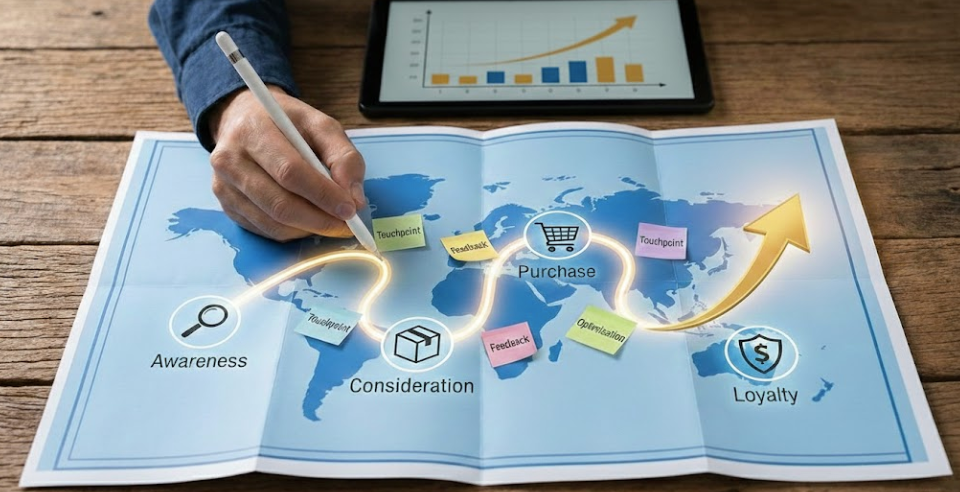
In today’s competitive eCommerce environment, understanding your customers has never been more essential. Every click, scroll, and purchase tells a story. Yet, most brands focus too narrowly on transactions instead of experiences. That’s where customer journey mapping becomes your secret weapon — a visual and strategic method for uncovering what customers think, feel, and do from first contact to final purchase (and beyond).
When used effectively, journey mapping not only improves customer satisfaction but also drives measurable growth in sales. This guide will walk you through how to transform your understanding of the customer journey into higher conversions, deeper loyalty, and sustainable business success.
Customer journey mapping is the process of visually representing the steps a customer takes when interacting with your brand. From discovering your store through ads or search results to exploring products, reading reviews, and finally making a purchase — each stage tells you where opportunities exist to improve engagement and remove friction.
At its core, journey mapping aims to align your business perspective with that of your customer. It’s not just about documenting steps but about understanding emotions, motivations, and barriers. A well-crafted map becomes a living strategy that influences marketing, product development, and customer service decisions.
Without a clear journey map, businesses often make assumptions about what customers want. These assumptions lead to gaps — confusing checkout flows, irrelevant emails, or delayed responses. By visualizing the customer journey, brands can:
Before mapping begins, it’s vital to understand the typical stages a customer moves through. Though models vary, most journeys include these five primary phases:
These stages represent both linear and emotional progressions. In reality, customers may loop back and forth — revisiting reviews or abandoning carts before returning to buy later. A great journey map accounts for this fluidity, helping your brand anticipate behaviors in real time.
To build an accurate journey map, start with real data — not assumptions. The more insights you have, the more actionable your map becomes.
You can gather this information through:
Once collected, this data helps segment customers based on persona — for example, “first-time shoppers,” “returning buyers,” or “high-value repeat customers.” Each persona experiences your brand differently, so mapping them separately ensures precision.
With the data ready, translate it into a visual story. Begin by defining your chosen persona and listing all possible touchpoints. These may include your website, ads, email campaigns, mobile app, or even offline experiences.
A strong customer journey map should include:
Modern tools like Miro, Lucidchart, or Figma make it easy to design detailed, shareable maps. Some brands even integrate real-time analytics dashboards into their maps, allowing them to update journeys dynamically as customer behavior evolves.
Once you can visualize your customer’s full experience, the next step is to locate areas where sales improvements are possible. These often fall into three categories:
For example, if your journey map shows many users abandon carts at the payment page, simplifying that step or adding more payment options can directly increase conversion rates.
In short, journey mapping bridges the gap between insight and revenue — every optimization is guided by real user behavior.
Today’s customers expect personalization at every step. Journey mapping helps you see where individualization makes the biggest impact.
You can personalize based on:
For instance, sending a tailored follow-up email when a customer leaves a product page signals attentiveness and can recover lost sales. Similarly, showing region-specific shipping information or local currency pricing builds trust in global markets.
Personalization converts insights into emotional resonance — customers feel recognized, not targeted.
Modern journey mapping goes beyond static visuals. When combined with automation tools, it becomes a dynamic sales engine that reacts to customer actions in real time.
Automation platforms like HubSpot, Klaviyo, or ActiveCampaign allow you to trigger messages, discounts, or product recommendations automatically based on where the customer is in their journey.
For example:
These touchpoints reduce manual effort while ensuring customers receive the right message at the right time.
The most effective journey maps aren’t just marketing tools — they’re company-wide alignment blueprints. Every department plays a role in shaping the customer experience, and the map ensures everyone works toward the same goals.
Sharing the journey map across teams ensures consistency and fosters a customer-first mindset. The result: smoother collaboration and stronger brand trust.
Customer journey mapping is not a one-time effort — it’s a continuous optimization process. Markets change, technologies evolve, and customer expectations rise. Regularly revisit and update your map to reflect new data or behavioral shifts.
Track metrics like:
As you refine the map, test small improvements such as reworded CTAs or simplified navigation. Over time, these incremental gains compound into significant revenue growth.
Imagine a WooCommerce store selling eco-friendly apparel. Their journey mapping revealed that many customers added products to their carts but didn’t finalize the purchase. Further analysis showed confusion over sizing and shipping costs.
By clarifying size charts, adding free shipping thresholds, and sending personalized reminder emails, the brand increased conversion rates by 18% in two months.
This demonstrates how data-backed mapping not only identifies pain points but also inspires practical strategies that drive results.
Customer journey mapping isn’t just a visualization exercise — it’s a growth strategy grounded in empathy and precision. By understanding how your customers experience every touchpoint, you can remove friction, deliver value, and create lasting loyalty. When combined with automation and personalization, journey mapping turns insight into measurable sales outcomes.
In 2026 and beyond, the eCommerce brands that thrive will be those who continuously listen, adapt, and improve their customer journeys. If you invest time in mapping your customers’ paths today, you’re investing in tomorrow’s profitability, loyalty, and brand love.