 New to Shopify? Free trial, then $1/month for your first 3 months. Start free trial →
 Where is your store?
Ryviu works with both – pick yours to continue.








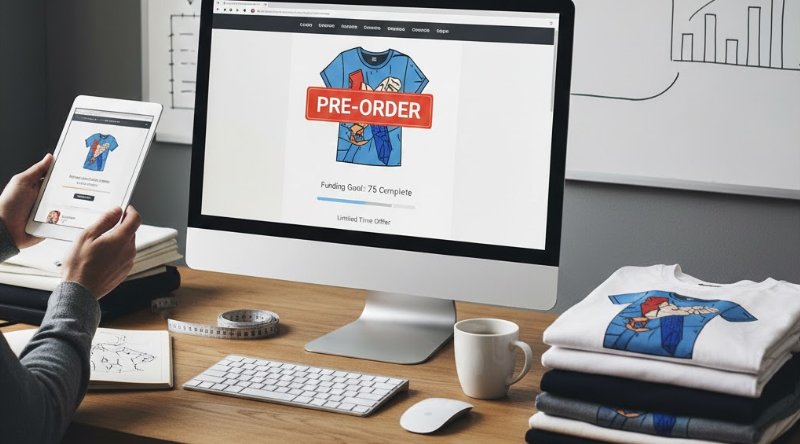
Launching new print-on-demand (POD) designs can feel exciting, but also risky. You invest time in creating artwork, planning campaigns, preparing product descriptions, and imagining how customers will respond—yet there’s always uncertainty about which designs will actually sell. Pre-orders offer a powerful solution to this challenge. They allow you to test market interest, validate demand, and gather customer feedback before producing a full collection.
When used strategically, pre-orders become a low-risk, high-insight way to launch designs that actually resonate. This guide explores how to use pre-orders effectively in POD, how to structure campaigns that feel natural and compelling, and the techniques that help you turn early interest into decisions that strengthen your long-term product development.
Pre-orders are uniquely suited for POD brands because print manufacturing starts only after an order is placed. This gives sellers freedom to experiment with new ideas without committing to inventory or large production runs. Pre-orders also turn testing into a marketing moment—something that generates excitement instead of uncertainty.
Traditional product launches require upfront investment. POD eliminates production risk, but you still risk time, ad spend, and opportunity cost when launching designs without knowing demand. Pre-orders give you early proof of interest, letting you cut designs that won’t perform well.
Instead of guessing what people might like, pre-orders allow you to see what people are willing to pay for. Real orders carry far more weight than polls or likes on social media. They give you:
These insights help refine both the product and the audience targeting.
Pre-orders turn the unknown into anticipation. Customers feel they’re getting early access to something new, while you gather valuable data. This creates:
Pre-orders transform testing into a marketing engine.
Before starting a pre-order campaign, it’s helpful to create designs that are test-friendly. These are not final collections but early concepts that can evolve based on customer feedback.
Having flexible design elements makes it easier to test multiple variations. Modular artwork lets you adjust colors, fonts, and visual elements quickly. When customers provide feedback, you can apply changes without recreating designs from scratch.
The strength of pre-orders lies in comparisons. You want customers to choose between options, helping you identify what excites them the most. Useful variations include:
Offering variation encourages deeper engagement and reveals preferences clearly.
Your pre-order campaign will be more effective if each design has a narrative. People buy emotion first and product second. A compelling story helps set expectations and reduces hesitation.
Stories that resonate might include:
When designs connect emotionally, your pre-order data becomes more meaningful.
Once designs are ready, you need the technical setup to accept pre-orders smoothly. This ensures customers know what they're buying, when it will ship, and why they should participate early.
Many tools enable pre-order functionality without altering your fulfillment workflow. These apps allow:
A clean pre-order setup gives customers confidence and helps you operate efficiently.
Customers should clearly understand:
Transparency builds trust and prevents refund requests.
Scarcity encourages faster decisions. You can emphasize:
These elements push engagement and provide stronger proof of concept.
A pre-order campaign is not only a testing mechanism—it is also a marketing event. Building hype increases your chances of gathering meaningful data and attracting serious buyers.
Don't start taking orders the moment you finish your designs. Instead, create a build-up to maximize impact.
Strategies to warm your audience include:
Anticipation increases click-through rates and boosts early conversions.
Since POD products are visual by nature, your pre-order campaign must showcase the designs clearly. Use:
The more immersive the visuals, the higher the pre-order conversion rate.
Customers love being part of your creative process. Position the pre-order as a collaborative journey.
Explain that:
This sense of participation creates stronger customer loyalty.
Once your pre-order campaign gathers traction, the real value emerges through the data you collect. This information will guide your final decisions about which designs to fully launch and how to refine them.
Some designs will stand out clearly. Look for patterns such as:
These patterns reveal what truly resonates.
Sales alone do not tell the full story. Sometimes high interest with low purchases indicates weak pricing or unclear messaging. Examine:
Combined with sales data, engagement metrics show the full customer journey.
Pre-order customers are highly motivated and willing to share opinions. Ask them:
Survey responses help refine designs before full launch.
A strong pre-order campaign isn’t complete without a reliable fulfillment process. Even if customers know they're ordering early, they still expect timely delivery and clear communication.
Coordinate production schedules with your print provider. POD gives you flexibility, but you should still plan:
Organized fulfillment maintains trust and prevents post-launch issues.
Communication during fulfillment is crucial. Customers who pre-order expect transparency. Send updates such as:
Even simple updates reduce support tickets and improve satisfaction.
If you notice bottlenecks or delays, document them. These insights will help you refine logistics for your next pre-order launch.
After analyzing the results and fulfilling customer orders, it’s time to turn your winning designs into permanent store products. Pre-orders give you a clear roadmap for what deserves a full release.
You may discover:
Choose only the designs with meaningful demand. Avoid launching everything, as this dilutes brand focus.
Your pre-order customers are your first “proof of demand.” Encourage them to share:
These assets strengthen your main launch and amplify trust.
Now you know:
Use this data to refine your advertising. Create lookalike audiences, segment buyer profiles, and build creatives around your most successful designs.
One of the biggest advantages of pre-orders is scalability. Once you get comfortable with the process, you can use it repeatedly to explore new niches and themes.
Instead of launching blindly, you can test:
This reduces wasted time and helps you pivot quickly.
When a theme performs well, use pre-orders to build deeper collections around it. Customers who pre-order once often pre-order again.
Pre-orders are one of the most effective tools for testing POD designs, reducing risk, and capturing authentic customer interest before launching a full collection. They allow you to test designs realistically, gather meaningful data, refine your creative direction, and scale only the products that your customers truly want. With the right approach—clear communication, strategic variations, strong visuals, transparent timelines, and thoughtful analysis—pre-orders become more than a testing method. They become a marketing engine, a customer engagement strategy, and an insight-driven way to build a more profitable POD business. When used consistently, pre-orders turn design experimentation into sustainable growth, helping you create products that resonate deeply with your audience and drive long-term success for your brand.




