New to Shopify? Free trial, then $1/month for your first 3 months. Start free trial →
 Where is your store?
Ryviu works with both – pick yours to continue.







In today’s world of instant gratification, customers expect their online orders to arrive almost as fast as they can click “Buy Now.” Same-day delivery, once a luxury reserved for tech giants like Amazon, is rapidly becoming the new standard. However, the traditional model of large, centralized fulfillment centers located on the outskirts of cities can no longer keep up with the demand for speed. This shift has given rise to micro-warehousing, a powerful logistics innovation that brings inventory closer to consumers, enabling same-day—or even same-hour—delivery.
This article explores how micro-warehousing is reshaping eCommerce logistics, the technologies driving it, its benefits, challenges, and what it means for the future of retail.
For years, eCommerce logistics revolved around large distribution centers strategically positioned to serve broad regions. While efficient for bulk shipments, this model struggled to deliver on the growing demand for ultra-fast fulfillment. Consumers now expect immediacy—particularly in urban areas where same-day delivery can determine whether a sale is made or lost.
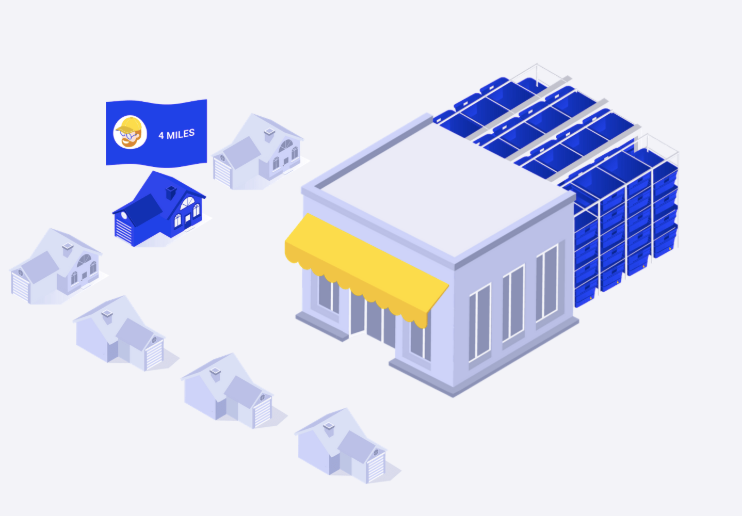
Micro-warehousing flips the script by decentralizing fulfillment. Instead of one massive warehouse per region, businesses operate multiple smaller facilities located closer to high-density customer areas. These “micro-fulfillment centers” (MFCs) can be as compact as a few thousand square feet and often occupy underutilized retail spaces, garages, or even parts of shopping malls.
This shift allows online retailers and logistics providers to store inventory just miles away from their end customers, drastically cutting down delivery times and costs.
Consumer behavior has fundamentally evolved. Studies show that over 60% of online shoppers abandon their carts if delivery options are too slow or expensive. With competition intensifying, speed is no longer a perk—it’s a promise. Micro-warehousing offers businesses a way to keep that promise while optimizing fulfillment efficiency.
By enabling local, rapid order processing, companies can reduce last-mile delivery costs, minimize carbon emissions, and enhance customer loyalty.
Micro-warehousing relies on a network of localized, automated fulfillment nodes supported by advanced technology and real-time data. The core idea is simple: store popular, fast-moving products near customers so orders can be fulfilled and dispatched immediately.
Together, these elements create a fulfillment ecosystem where products are constantly moving in sync with consumer demand, allowing same-day or next-day delivery without overwhelming the main supply chain.
The backbone of micro-warehousing lies in robotics and automated storage systems. These technologies allow small facilities to handle high order volumes efficiently. Autonomous robots can retrieve products, deliver them to packing stations, and even handle last-mile dispatch coordination—all within a fraction of the space and time of traditional warehouses.
Companies like Fabric, Takeoff Technologies, and Ocado are pioneers in this field, developing modular micro-fulfillment systems that can fit inside existing retail locations.
Data synchronization is critical. Inventory management systems (IMS) ensure every micro-warehouse has an up-to-date view of what’s in stock, what’s selling, and what’s being restocked. Shopify and other eCommerce platforms can integrate directly with these systems, offering businesses full transparency over their distributed inventory.
AI doesn’t just manage inventory—it predicts it. By analyzing historical sales, seasonal patterns, and even social trends, AI systems can forecast product demand for each local area. This helps ensure that micro-warehouses always have the right products ready for instant dispatch, reducing stockouts and unsold inventory.
The Internet of Things (IoT) plays a vital role in monitoring conditions within micro-warehouses—temperature, humidity, and even shelf utilization. Combined with real-time tracking for outgoing orders, IoT provides complete visibility from shelf to doorstep.
The most obvious advantage is speed. With products already stationed close to the customer, fulfillment time drops drastically. Same-day delivery becomes not only possible but cost-effective, giving smaller retailers the chance to compete with giants like Amazon and Walmart.
The last mile is the most expensive leg of delivery, often accounting for over 50% of total logistics costs. Micro-warehousing minimizes travel distances and consolidates local deliveries, lowering transportation expenses and carbon emissions.
In eCommerce, delivery speed directly impacts satisfaction and loyalty. By ensuring faster and more reliable delivery, brands can increase repeat purchases, improve reviews, and strengthen trust.
Micro-warehouses are modular and scalable. Retailers can quickly add or remove locations based on performance data, demand fluctuations, or new market entries. This flexibility allows eCommerce businesses to expand without heavy upfront investments.
Smaller, localized fulfillment centers lead to fewer long-haul shipments and reduced emissions. Combined with electric last-mile delivery vehicles or bike couriers, micro-warehousing supports a greener logistics model.
As consumer habits shift from physical shopping to online ordering, many retailers are reimagining how they use their existing stores. Dark stores—retail locations repurposed exclusively for online order fulfillment—are becoming more common. These spaces act as micro-warehouses where inventory is stored, packed, and shipped locally.
Major retailers like Target and Walmart already leverage their stores as micro-fulfillment hubs. This hybrid approach allows them to serve both walk-in and online customers with remarkable efficiency.
Smaller eCommerce brands without physical locations can partner with third-party logistics (3PL) providers that specialize in micro-fulfillment. Companies like ShipBob, Deliverr, and Flowspace offer shared micro-warehousing networks that allow merchants to store inventory in multiple local hubs.
This approach democratizes fast delivery, making it accessible even for small and medium-sized businesses.
While micro-warehousing offers numerous benefits, it’s not without challenges.
Building and maintaining automated micro-warehouses require significant investment in robotics, sensors, and data infrastructure. For smaller merchants, these costs can be prohibitive without third-party support.
Managing distributed inventory across multiple small locations can be logistically complex. Poor coordination or inaccurate forecasting may lead to stockouts in one location and overstock in another.
Micro-warehouses, by definition, have limited capacity. This means only high-demand or fast-moving products can be stored locally, requiring strong data-driven decision-making.
Urban logistics often face challenges like traffic congestion, zoning regulations, and delivery restrictions. These can limit the efficiency of micro-warehousing networks, especially in densely populated cities.
Despite these challenges, advancements in automation and predictive analytics continue to make micro-warehousing more practical and affordable every year.
Micro-warehousing aligns perfectly with the omnichannel retail movement. It supports services like buy-online-pickup-in-store (BOPIS), curbside pickup, and same-day local delivery. Retailers can use their physical presence to enhance digital convenience, bridging the gap between online and offline experiences.
As eCommerce becomes increasingly global, micro-warehousing networks can extend internationally. Regional hubs near major global cities could enable same-day delivery across borders, offering merchants new ways to serve international markets quickly and efficiently.
The next stage of evolution will see micro-warehousing integrated with AI-powered logistics orchestration. Intelligent systems will automatically decide where to stock products, which facility should fulfill an order, and which courier should deliver it—optimizing every decision for cost, time, and sustainability.
To prepare for a future dominated by micro-warehousing, eCommerce brands should:
By taking these steps today, businesses position themselves to thrive in the next phase of eCommerce logistics.
Micro-warehousing is more than a logistics innovation—it’s a transformation in how products move from store to doorstep. By decentralizing fulfillment and embracing automation, businesses can meet customer expectations for same-day delivery without sacrificing cost efficiency or sustainability.
As urban populations grow and digital shopping becomes universal, the ability to deliver faster, cleaner, and smarter will define retail success. Micro-warehousing represents the future of same-day delivery—a system where speed meets intelligence, where technology meets proximity, and where every click brings the product closer to the customer’s door.