New to Shopify? Free trial, then $1/month for your first 3 months. Start free trial →
 Where is your store?
Ryviu works with both – pick yours to continue.








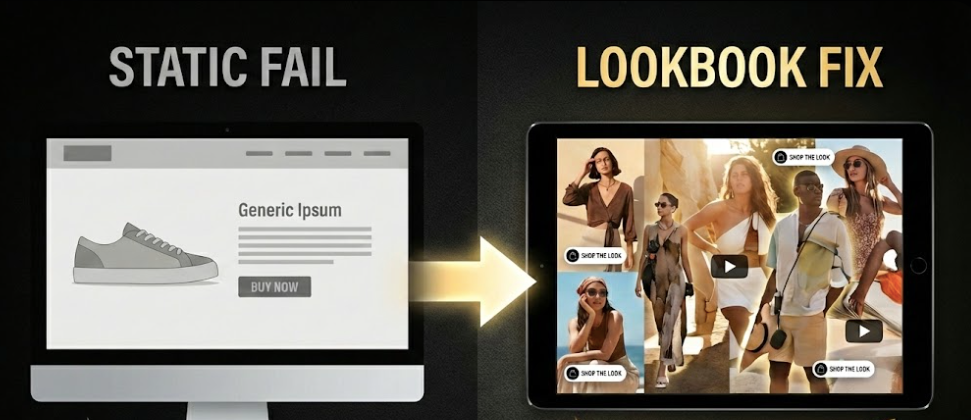
For years, the standard product page has followed the same formula: a few images, a block of text, a price, and an “Add to Cart” button. While this structure still works in some contexts, it increasingly fails to meet modern shopper expectations. Today’s consumers want inspiration, context, and confidence—not just specifications. Static product pages struggle to deliver that experience, especially in competitive eCommerce niches. This is where lookbooks step in.
By transforming products into visual stories, lookbooks bridge the gap between browsing and buying. This article explores why static product pages fall short and how lookbooks reshape the shopping experience into something more engaging, persuasive, and conversion-friendly.
Static product pages were built to inform, not inspire. They focus on listing features, dimensions, and prices in a structured, predictable format. While this clarity is useful, it rarely sparks emotion or imagination.
Modern shoppers don’t just ask, “What is this?” They ask, “How does this fit into my life?” Static pages struggle to answer that question. A few isolated images and bullet points cannot easily communicate context, lifestyle, or real-world usage.
As competition grows and products become more interchangeable, information alone is no longer enough to persuade.
Shoppers have become accustomed to scrolling quickly and scanning visually. Static layouts, especially those that look similar across stores, blend together. When every product page follows the same pattern, none stand out.
This sameness leads to:
Without a compelling reason to stay, shoppers move on—even if the product itself is solid.
Consumer behavior has shifted from purely goal-driven shopping to discovery-driven browsing. Social platforms, visual feeds, and creator content have trained users to explore ideas before committing to a product.
In this environment, static product pages feel abrupt. They jump straight to selling without allowing shoppers to explore, imagine, or connect.
Lookbooks align better with how people naturally browse today—visually, contextually, and emotionally.
Visual storytelling helps shoppers understand not just what a product is, but what it represents. Seeing a product in use, styled in different ways, or placed in real environments reduces uncertainty and increases desire.
This is especially important for categories where:
Static pages struggle to deliver this narrative on their own.
One of the biggest reasons shoppers hesitate is lack of context. Static pages often show products in isolation, stripped of environment and scale.
Without context, shoppers are left to imagine how a product looks, feels, or fits. This mental effort increases friction and doubt.
Lookbooks remove this burden by showing products in real-world scenarios, making the decision feel easier and safer.
Specifications matter, but they rarely close the sale. Long text blocks are often skimmed or ignored, especially on mobile devices.
When product understanding relies too heavily on text, engagement drops. Visual learning is faster, more intuitive, and more persuasive.
Static pages that lean on text miss an opportunity to communicate value instantly.
A lookbook transforms individual products into part of a broader experience. Instead of presenting items one by one, it shows how they work together or fit into a lifestyle.
This approach mirrors how people think about purchases. Customers rarely want a product in isolation; they want the outcome it enables.
By showing products in context, lookbooks answer emotional questions that static pages cannot.
Lookbooks guide users through a visual journey. They encourage exploration rather than demanding immediate decisions.
This visual flow:
When shopping feels less transactional, conversion becomes a natural next step.
Static pages often force shoppers to evaluate products individually. This can be overwhelming, especially in stores with many similar items.
Lookbooks simplify decisions by curating products into cohesive collections or themes. This curation acts as a recommendation, helping shoppers trust the brand’s taste and judgment.
Fewer decisions lead to faster, more confident purchases.
When products are shown together in a lookbook, customers naturally consider buying more than one item. This increases average order value without aggressive upselling.
Lookbooks subtly demonstrate compatibility and styling possibilities, making bundles feel organic rather than forced.
This approach is particularly effective in fashion, home decor, and lifestyle niches.
Lookbooks borrow heavily from editorial content and social media. They feel closer to a magazine spread or an Instagram story than a traditional storefront.
This familiarity makes them comfortable and engaging. Shoppers don’t feel like they are being sold to—they feel like they are being inspired.
As content and commerce continue to merge, lookbooks sit naturally at the intersection.
Lookbooks are not just for product pages. They support discovery at every stage of the customer journey.
They can be used on:
This flexibility makes them a powerful experience layer across the store.
Mobile shopping dominates eCommerce, yet many product pages are still designed with desktop layouts in mind.
Lookbooks work well on mobile because they emphasize vertical scrolling, large visuals, and minimal friction. This aligns perfectly with how users interact with their phones.
Instead of clicking through galleries and tabs, shoppers scroll naturally through a story.
On mobile, attention spans are shorter. Lookbooks communicate value quickly through visuals, reducing the need for reading.
This makes them especially effective for capturing interest and keeping users engaged on smaller screens.
Many eCommerce stores use the same themes, layouts, and page structures. This creates a sea of sameness where products compete primarily on price.
Lookbooks offer a way out. They add a distinctive layer of experience that is harder to copy and easier to remember.
When shoppers recall a store because of how it made them feel, not just what it sold, differentiation is achieved.
Lookbooks are an extension of brand identity. Colors, styling, pacing, and imagery all communicate values and positioning.
A minimalist brand, a bold fashion label, or a cozy lifestyle store can each express their personality through lookbooks more effectively than through text alone.
This consistency builds recognition and trust over time.
Lookbooks fail when they are treated as purely aesthetic additions. Without clear links to products or purchasing paths, they become distractions.
Effective lookbooks balance inspiration with usability. Shoppers should be able to move from admiration to action effortlessly.
Too many images without narrative or flow can overwhelm users. Lookbooks should guide, not flood.
Clear sequencing, intentional curation, and subtle calls to action keep the experience focused.
The success of lookbooks is often reflected in engagement rather than immediate conversion.
Key indicators include:
Over time, these signals translate into stronger conversion performance.
Lookbooks influence how shoppers perceive the brand. They communicate effort, care, and creativity.
This perception compounds, making future marketing more effective and reducing reliance on discounts or aggressive tactics.
Static product pages are no longer enough in an eCommerce landscape driven by inspiration, context, and experience. While they deliver information, they fail to capture imagination or build emotional confidence. Lookbooks fix this gap by turning products into stories, guiding discovery, and aligning with how modern shoppers browse and decide.
They reduce friction, increase engagement, and create a more human shopping experience. As competition intensifies and attention becomes harder to earn, lookbooks are not just a design upgrade—they are a strategic advantage for brands that want to stand out and convert more effectively.