New to Shopify? Free trial, then $1/month for your first 3 months. Start free trial →
 Where is your store?
Ryviu works with both – pick yours to continue.








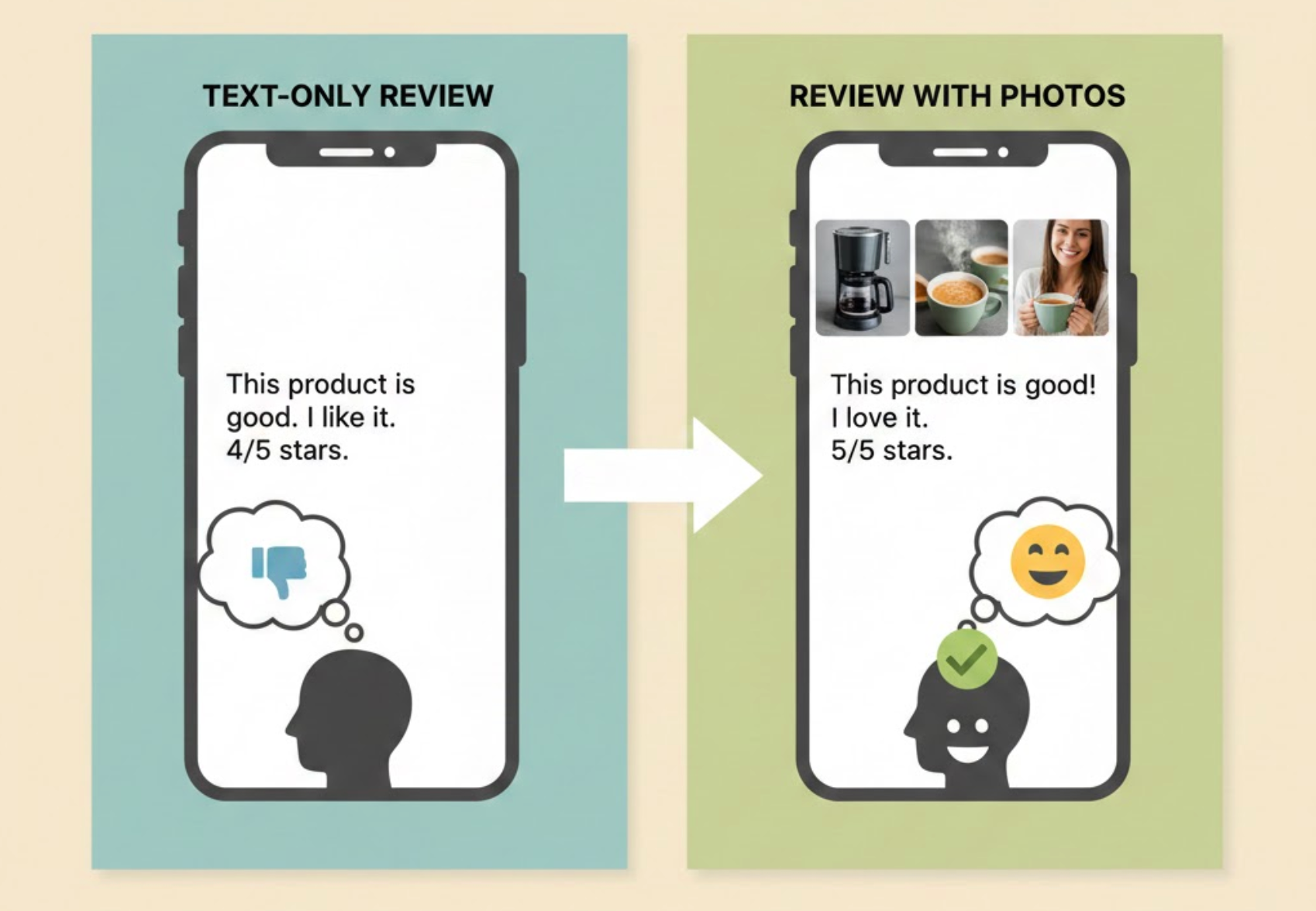
Trust is the foundation of every successful eCommerce transaction. When shoppers walk into a physical store, they can touch products, inspect details, ask questions, and make judgments based on direct experience. Online shopping removes all of those reassurances. Instead, customers must rely on digital signals to decide whether a product is worth their money.
Among all trust signals, product descriptions, brand photography, star ratings, and guarantees, customer reviews play the most critical role. And within reviews, those that include real customer photos consistently outperform text-only feedback in terms of credibility, influence, and conversion impact.
Photo reviews do more than add visual interest. They reduce uncertainty, validate claims, and help shoppers feel confident that what they see is what they will actually receive. This is why modern consumers increasingly trust reviews with photos more than words alone.
Text reviews are inherently subjective. Phrases like “great quality,” “better than expected,” or “worth the price” depend entirely on personal interpretation. What feels “high quality” to one shopper may feel average to another.
Photos eliminate this ambiguity by turning abstract claims into tangible proof. A single image can show:
Instead of imagining what a reviewer means, shoppers can see the reality for themselves. This visual confirmation gives shoppers control over the evaluation process, which significantly increases trust.
Professional product photography is essential for eCommerce, but shoppers understand its limitations. These images are carefully staged, well-lit, and optimized to highlight a product’s best features. While helpful, they represent an idealized version of reality.
Customer-uploaded photos feel more honest because they are unfiltered. They show products:
This raw quality signals authenticity. Shoppers don’t expect perfection, they want transparency. When they see customer photos that include small flaws or variations, it reassures them that the brand isn’t hiding anything.
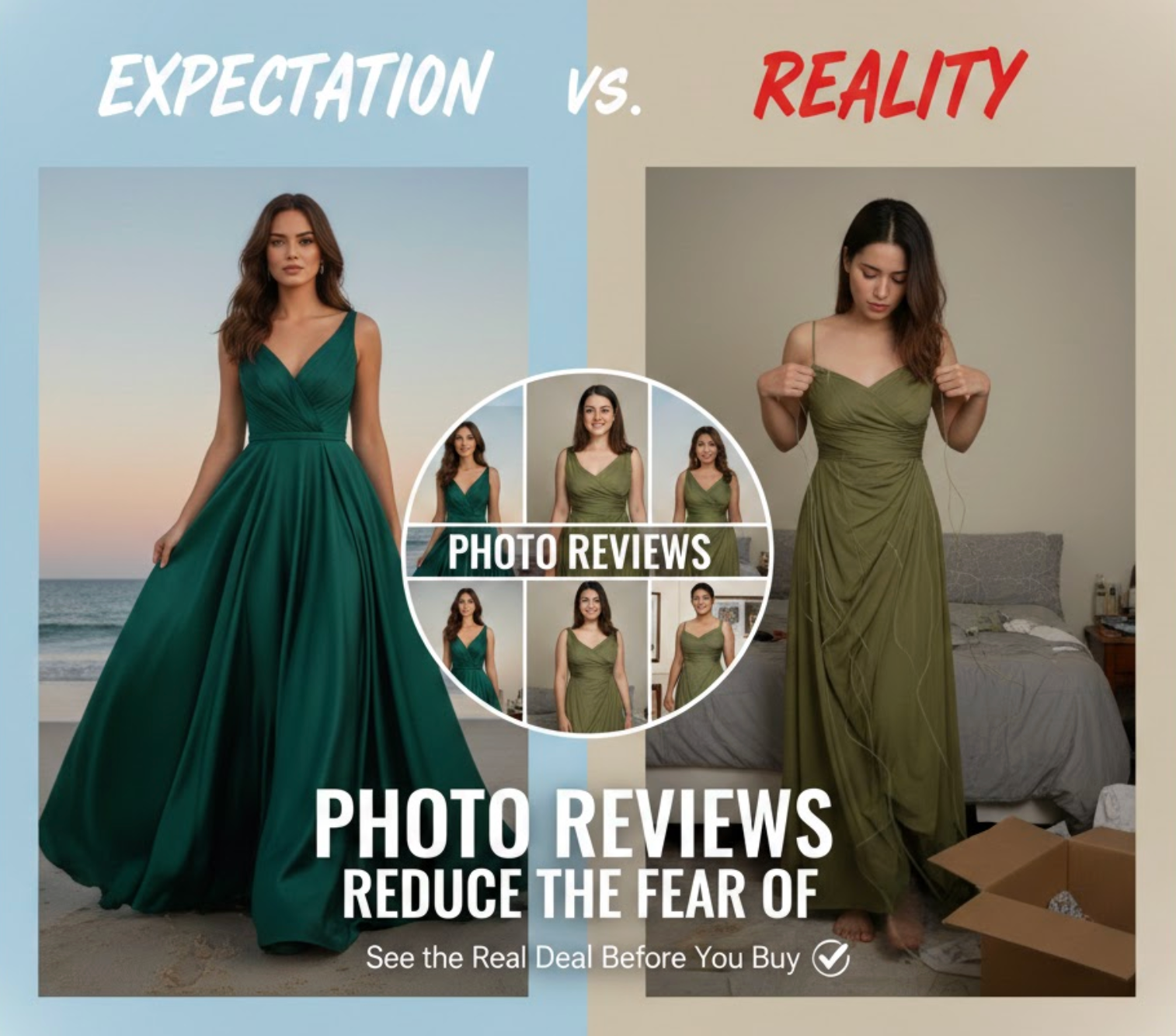
One of the biggest barriers to online purchases is fear: What if the product looks different in real life? What if it doesn’t fit? What if the quality isn’t what I imagined?
This expectation gap is a major cause of abandoned carts and returns. Photo reviews directly address this problem by showing what the product looks like once it leaves the warehouse and enters real-world use.
They help shoppers understand:
By aligning expectations before purchase, photo reviews reduce disappointment after delivery and make shoppers feel safer committing to a purchase.
Human brains process images far faster than text. In fast-paced online shopping environments, most customers don’t read every review, they scan.
Photo reviews allow shoppers to:
This speed matters. When shoppers can visually confirm a product’s suitability without extensive effort, decision-making becomes smoother and more confident. Less friction means fewer doubts, and fewer doubts lead to higher conversions.
Leaving a review with photos requires extra effort. The customer must take pictures, upload them, and often provide context. Shoppers subconsciously associate this effort with authenticity.
A photo review signals:
In an era where fake reviews are widespread, visual proof acts as a credibility filter. Shoppers trust photo reviews more because they feel harder to fabricate and easier to verify.
Shopping decisions are rarely purely rational. Emotion plays a major role, especially for lifestyle-oriented products.
When shoppers see photos from people who look like them or live similar lives, they begin to imagine themselves using the product. This emotional connection builds comfort and trust.
Photo reviews humanize eCommerce by turning products into lived experiences rather than abstract listings. This effect is particularly powerful in categories such as:
Relatability turns curiosity into confidence.
Social proof becomes stronger when it is visible and repeated. A single photo review is helpful. A collection of photo reviews from many customers is persuasive.
When shoppers see multiple images showing different people, environments, and use cases, it sends a powerful message: this product is widely used and consistently delivers value.
This visual volume reduces the impact of outliers or negative assumptions and reinforces the perception that the product is a safe, popular choice.
Interestingly, photo reviews don’t need to look perfect to be effective. In fact, overly polished customer images can feel suspicious.
Slight imperfections, uneven lighting, casual angles, visible wear, signal honesty. They tell shoppers that these photos weren’t staged or curated by the brand.
Imperfection sets realistic expectations. And when products meet realistic expectations, customer satisfaction increases while returns decrease. Transparency, not perfection, is what builds trust.

Photo reviews don’t only influence product pages. They support trust at multiple stages of the buyer journey.
Before purchase, they reduce uncertainty. During decision-making, they confirm expectations. After purchase, they reassure customers that they made the right choice.
This transparency leads to:
Trust built before the sale carries through long after checkout.
Beyond immediate conversions, photo reviews contribute to long-term brand trust. When shoppers feel informed and confident, they are more likely to return and recommend the brand to others.
Over time, a growing library of customer photos becomes a powerful brand asset, one that is difficult for competitors to replicate. Authentic customer content builds credibility that advertising alone cannot achieve.
Understanding the value of photo reviews is only the first step. The real challenge is encouraging customers to actually leave them.
Most shoppers are willing to share photos, but only if the process is easy and well-timed. Complicated forms or poorly timed requests discourage participation.
This is where review tools like Ryviu naturally support the experience. Ryviu helps merchants collect photo reviews by simplifying post-purchase review requests and making it easy for customers to upload images alongside their feedback. Instead of forcing customers to take extra steps, brands can gently prompt them at the right moment, when the product is fresh in their mind.

When these photo reviews are displayed clearly on product pages, they become immediate trust signals. Shoppers don’t just read opinions; they see real proof from people who have already bought and used the product, reinforcing confidence without disrupting the shopping experience.
Shoppers trust reviews with photos more than text because images remove uncertainty, validate claims, and humanize the online shopping experience. They provide visual proof, emotional reassurance, and strong social validation, elements that text alone struggles to deliver.
For eCommerce brands, encouraging photo reviews is not just about adding visuals to a product page. It is a trust-building strategy that helps shoppers buy with confidence, reduces post-purchase regret, and strengthens long-term customer relationships.
In a digital marketplace where trust determines success, photo reviews are no longer optional, they are essential.