New to Shopify? Free trial, then $1/month for your first 3 months. Start free trial →
 Where is your store?
Ryviu works with both – pick yours to continue.








Surveys are an essential tool for gathering valuable insights and understanding public opinion. However, their effectiveness hinges on the ability to maintain objectivity and eliminate bias. Biased survey questions can inadvertently sway respondents' answers, compromising the integrity and accuracy of the data collected.
In this article, we will explore 7 examples of biased survey questions that can lead to misleading conclusions. By recognizing these pitfalls, researchers, policymakers, and organizations can enhance the validity of their surveys and make informed decisions based on unbiased and honest responses.
Let's delve into these instances!
Biased survey questions are inquiries that unintentionally or intentionally steer respondents towards particular answers, skewing the data and compromising the objectivity of the survey.
These questions may use emotionally charged language, present leading information, or make assumptions that influence participants' responses. Biases can arise from the wording, tone, or order of the questions, as well as the choice of response options provided.
As a result, biased survey questions can yield inaccurate or misleading data, hindering the validity and reliability of the survey's findings. Identifying and eliminating biased questions is crucial to ensure that surveys accurately reflect the true opinions and perspectives of the respondents.
It is your responsibility as the survey creator to minimize bias to encourage honest responses. So how do you do that?
Identifying biased survey questions involves careful examination of the wording, structure, and context of each question. Look for leading language that nudges respondents toward a particular response, or loaded statements that evoke emotional reactions. Watch out for double-barreled questions that combine multiple issues and vague questions lacking clarity. Additionally, be alert to dichotomous questions offering only extreme response options. Analyze the question order for any potential influence on subsequent responses.
The easiest way is to know how different types of biased survey questions work and take action to minimize them.
Surveys are a powerful tool for gathering valuable data and insights. However, the way survey questions are crafted can significantly impact the quality and accuracy of the responses received. Biases in survey questions can inadvertently influence participants' answers, leading to misleading or skewed results.
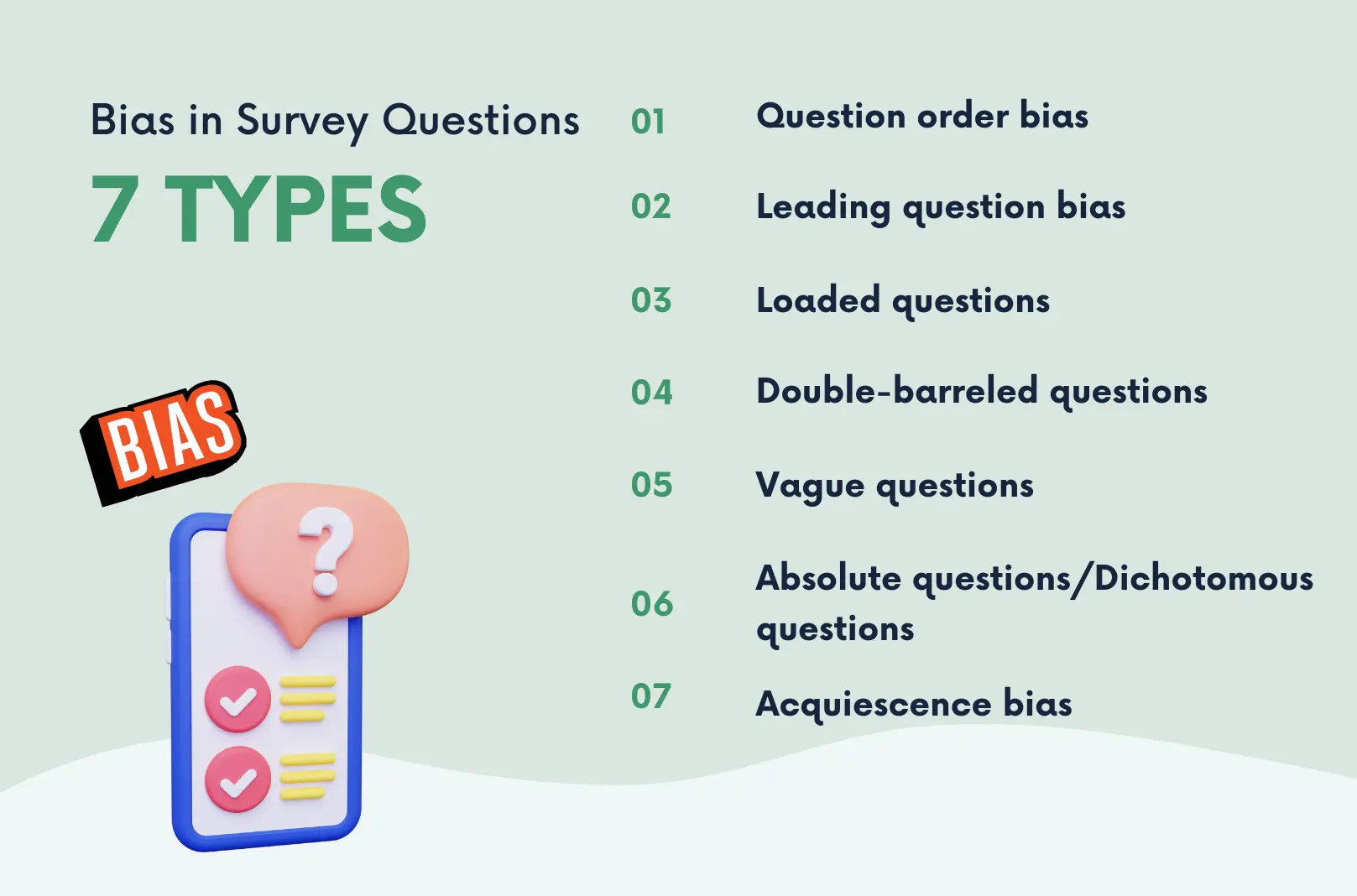
Here are 7 types of bias in survey questions and understand their potential impact on survey outcomes.
Question order bias occurs when the placement of one question influences the respondent's perception of subsequent questions.
For example, if a survey begins with questions about satisfaction with a product or service before delving into specific aspects, respondents may carry their initial feelings into later questions, potentially distorting their responses. To mitigate this bias, survey designers should ensure a logical and unbiased flow of questions, allowing respondents to provide impartial answers for each item.
Leading questions subtly encourage respondents to answer in a particular way by hinting at a preferred response or expressing a particular viewpoint. These questions often sway participants' opinions and can be used intentionally or unintentionally.
For instance, asking, "Don't you agree that the new and improved version of our product is fantastic?" presupposes that the product is improved, leading respondents towards a positive response. To avoid leading question bias, questions should be framed neutrally and avoid guiding participants to specific conclusions.
Loaded questions are designed to evoke an emotional response or predispose respondents towards a particular answer. They may contain emotionally charged language or present a scenario that influences the participant's opinion.
An example of a loaded question is, "Do you support the responsible and ethical treatment of animals, or do you condone animal cruelty?" This question assumes that one option is responsible and ethical while the other is cruel. To maintain objectivity, survey questions should be free from any emotional manipulation and strive to present options without bias.
Double-barreled questions combine two or more distinct issues within a single question, making it challenging for respondents to provide clear and accurate answers. Respondents might agree with one part of the question but disagree with another, leading to confusion and biased responses.
For instance, asking, "Are you satisfied with the product's quality and price?" assumes that respondents have the same sentiment about both aspects. To prevent double-barreled question bias, each topic should be addressed separately, allowing for more precise and unbiased feedback.
Vague questions lack clarity or fail to define key terms, leading to ambiguity in respondents' interpretation. When participants are unsure about what the question is asking, they may guess or provide random responses, resulting in unreliable data.
For example, asking, "Do you think the service is satisfactory?" without specifying the aspects of the service being evaluated can lead to subjective and inconclusive answers. Survey questions should be explicit and well-defined, leaving no room for misinterpretation.
Absolute or dichotomous questions provide respondents with only two extreme response options, typically "yes" or "no." These questions oversimplify complex issues and fail to capture the nuances of participants' opinions.
For instance, asking, "Do you support this policy, yes or no?" limits respondents' ability to express nuanced views or alternative perspectives. Instead, survey questions should offer a range of response options, allowing participants to express their opinions more accurately.
Acquiescence bias, also known as yea-saying or nay-saying bias, refers to respondents' tendency to agree or disagree with statements without thoughtful consideration. Some individuals may default to agreeing with all statements, while others may default to disagreeing, irrespective of the content. This bias can lead to unreliable data as respondents fail to provide genuine responses.
To counter acquiescence bias, researchers may use break the pattern questions to keep things interesting, like image choice, matrix, voice-over etc.
Biases in survey questions can significantly impact the reliability and validity of survey data. Understanding and recognizing these seven types of bias - question order bias, leading question bias, loaded questions, double-barreled questions, vague questions, absolute questions/dichotomous questions, and acquiescence bias - is crucial for designing unbiased surveys that yield accurate and meaningful insights.
By employing careful question construction and language, survey designers can ensure that respondents' answers are not unduly influenced, thereby enhancing the overall quality of survey research.