New to Shopify? Free trial, then $1/month for your first 3 months. Start free trial →
 Where is your store?
Ryviu works with both – pick yours to continue.








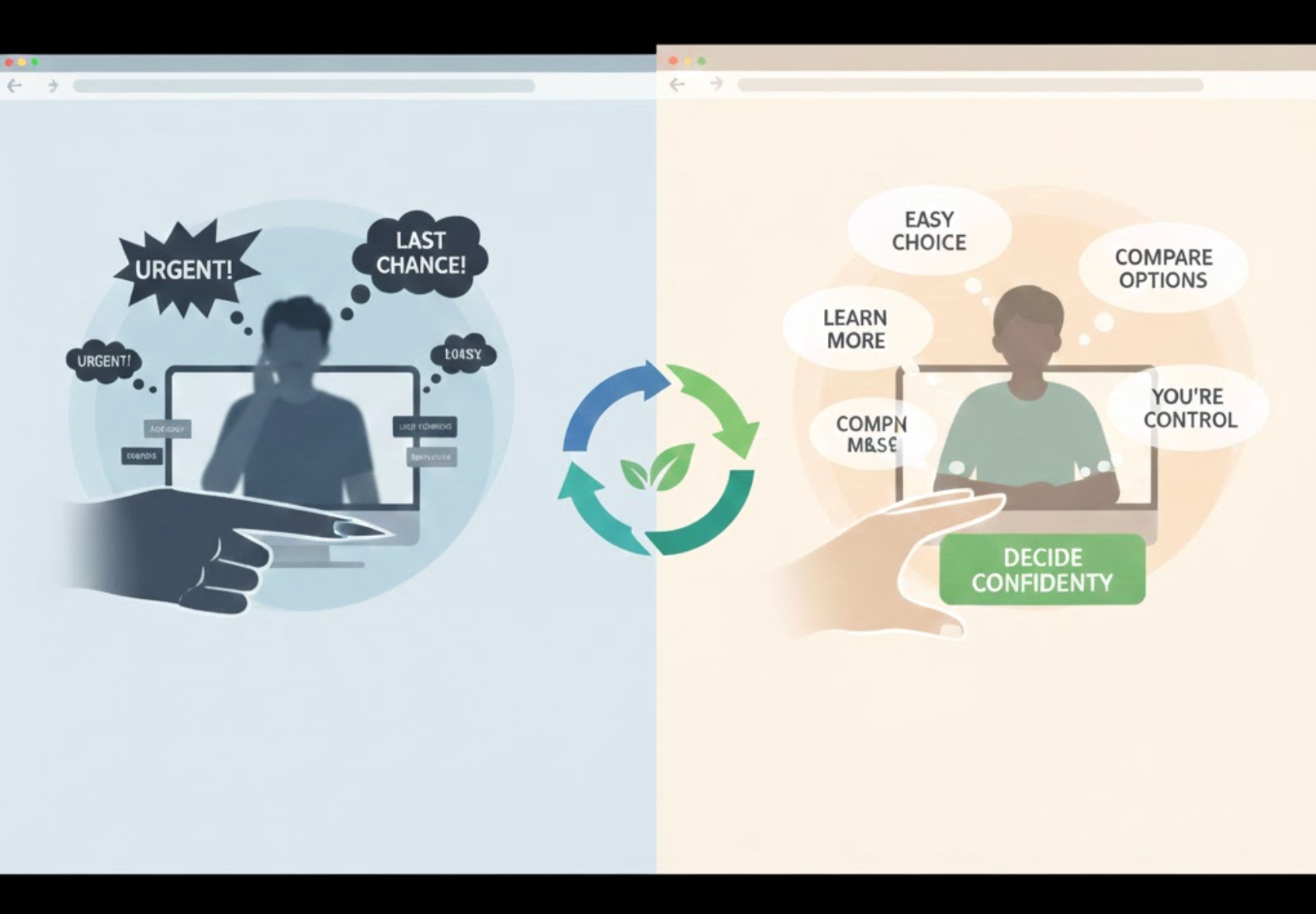
Conversion Rate Optimization (CRO) has long been associated with growth, performance, and efficiency. At its best, CRO helps businesses understand user behavior and improve digital experiences in ways that benefit both customers and companies. However, as optimization techniques have evolved, so have concerns about manipulation, deception, and short-term thinking. This tension has given rise to an increasingly important concept: Ethical CRO.
Ethical CRO is not about rejecting optimization or persuasion altogether. Instead, it’s about redefining how conversions are achieved, by prioritizing transparency, respect, and long-term trust over quick wins. In this article, we’ll explore what Ethical CRO truly means, why it has become essential in modern digital marketing, and how businesses can apply it without sacrificing results.

Ethical CRO is the practice of improving conversion rates while respecting user intent, autonomy, and understanding at every stage of the journey. Rather than pushing users toward a decision through pressure or confusion, ethical optimization focuses on helping users make informed and confident choices that genuinely serve their needs.
Traditional CRO often asks, “How can we remove friction to increase conversions?” Ethical CRO expands that question to, “Which friction is unnecessary, and which friction protects users from poor decisions?” This distinction is subtle but powerful. Not all friction is bad, sometimes it exists to help users pause, reflect, and choose correctly.
By reframing conversion as a mutual value exchange rather than a one-sided win, Ethical CRO shifts the focus from maximizing clicks to maximizing satisfaction. As a result, conversions become more meaningful, sustainable, and aligned with long-term business health.
In today’s digital landscape, users are more informed, more skeptical, and more sensitive to manipulation than ever before. Practices that once went unnoticed, such as fake urgency or hidden costs, are now quickly identified and publicly criticized. This shift in user awareness makes ethical behavior not just a moral choice, but a strategic one.
At the same time, regulatory frameworks around the world are tightening. Privacy laws, consumer protection regulations, and platform policies increasingly penalize deceptive UX patterns. Businesses that rely on questionable CRO tactics face not only reputational damage, but also legal and financial risks.
Beyond compliance, there’s a deeper reason Ethical CRO matters: trust compounds. When users feel respected and informed, they are more likely to return, recommend the brand, and forgive occasional mistakes. This makes ethical optimization a critical foundation for long-term growth rather than a limitation on performance.
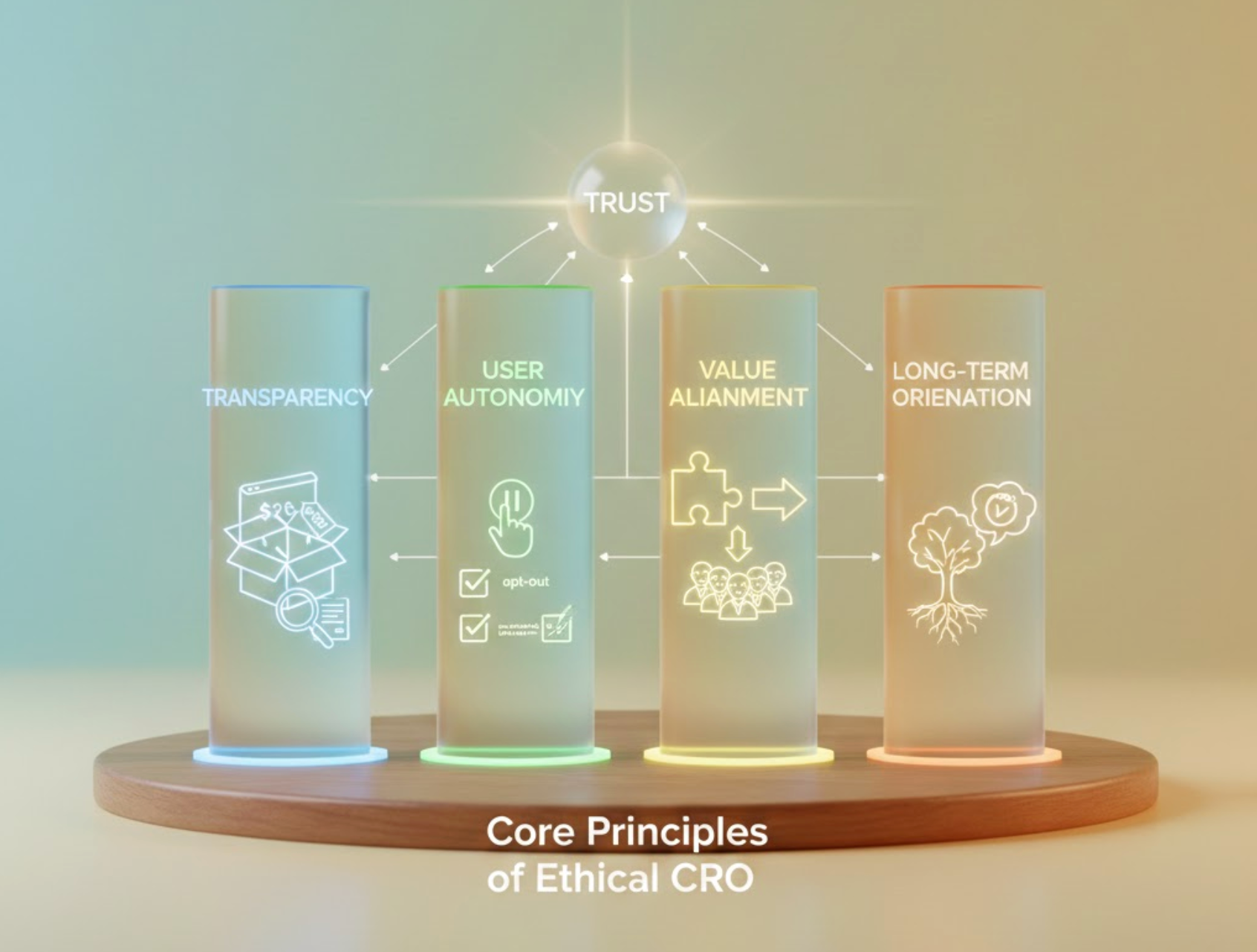
Ethical CRO is guided by a set of principles that influence every optimization decision, from copywriting to UX design and testing.
Transparency ensures that users clearly understand what they are signing up for, paying for, or committing to. This includes honest pricing, accurate product descriptions, and clear explanations of terms or limitations. When expectations match reality, trust naturally increases.
Ethical CRO respects a user’s right to choose, pause, or opt out. This means avoiding forced actions, pre-selected options, or penalties for changing one’s mind. Autonomy builds confidence, and confident users are more likely to convert willingly.
Conversions should happen because the offering genuinely solves a problem or meets a need. Ethical CRO avoids pushing mismatched users through the funnel and instead focuses on attracting and converting the right audience.
Rather than optimizing only for immediate uplift, ethical CRO considers downstream effects such as churn, support burden, refunds, and brand perception. This broader view leads to healthier, more resilient growth over time.
Psychological principles are a natural part of decision-making, and using them in CRO is not inherently unethical. The ethical line is crossed only when these principles are used to distort reality or exploit vulnerability.
For example, social proof can be incredibly effective when it reflects real customer experiences and honest feedback. However, inflating numbers or selectively showing only extreme praise undermines credibility. Similarly, urgency can help users act, but only when deadlines or stock limits are real and verifiable.
Ethical CRO uses psychology to reduce uncertainty, not to manufacture pressure. When psychological cues help users understand value faster and more clearly, they enhance the decision-making process rather than manipulate it.
Implementing Ethical CRO requires more than good intentions, it demands deliberate, structured action. Rather than focusing on isolated tactics, teams need to evaluate the entire user journey through the lens of clarity, fairness, and trust. This approach ensures that optimization improves both performance and user confidence.
Once this mindset is established, ethical improvements can be applied systematically across the funnel.
A/B testing is one of the most powerful tools in CRO, but it also carries ethical responsibility. Not every test that improves metrics should be considered acceptable.
Ethical A/B testing avoids experiments that intentionally mislead users or withhold critical information. For example, hiding fees, altering consent language, or obscuring cancellation details for one test group may produce short-term gains but cause real harm.
A useful guideline is to ask whether a test respects the user as a participant, not just a data point. If a variant could reasonably damage trust or cause regret, it’s a signal that the test may be ethically questionable, even if it performs well numerically.
Many ethical CRO problems do not come from intentionally deceptive behavior, but from overly narrow optimization goals. When teams prioritize conversion rate as the primary success metric, they often lose sight of how users feel during and after the conversion. Over time, this gap between metrics and experience can quietly erode trust and satisfaction.
Understanding where these mistakes commonly occur helps teams correct course before short-term gains turn into long-term damage.
Ethical CRO is not a trade-off between values and results, yet it is a strategy that strengthens both. Businesses that optimize ethically tend to attract more qualified customers, experience fewer disputes, and enjoy stronger brand loyalty.
Over time, these benefits compound. Trust lowers acquisition costs, improves retention, and turns customers into advocates. In competitive markets where products are easily replicated, ethical experience design becomes a powerful differentiator.
This makes Ethical CRO not just the “right” approach, but a smart and future-proof one.
Ethical CRO recognizes that behind every conversion is a real person making a real decision. By prioritizing transparency, respect, and genuine value, businesses can optimize performance without sacrificing integrity.
While manipulative tactics may deliver quick wins, ethical optimization builds something far more durable: trust. And in the long run, trust is the most powerful conversion driver of all.