New to Shopify? Free trial, then $1/month for your first 3 months. Start free trial →
 Where is your store?
Ryviu works with both – pick yours to continue.









Large-scale content cleanup is one of the most challenging tasks for any website or eCommerce brand. As your content library grows, outdated pages start to pile up, inconsistencies appear, and rankings fluctuate due to low-quality or under-optimized content. At the same time, search engines expect deeper expertise, higher relevance, and more consistent formatting than ever before.
AI tools have made this process dramatically easier, but they cannot fully replace human editing. Instead, the most effective approach is a hybrid workflow where AI handles volume and automation, while human editors provide accuracy, contextual judgment, and brand alignment. As you move from planning to execution, the balance between AI-driven automation and manual refinement becomes the key to sustainable, high-impact content improvement.
AI can process huge quantities of content, detect patterns, and produce drafts quickly. It accelerates tasks that would take humans days or weeks to complete, such as identifying duplicate content, rewriting sections, or expanding thin content. However, AI is not perfect, it may miss subtle context, introduce inaccuracies, or repeat generic phrasing. That’s where manual editing steps in to refine the final product.
This combination ensures you get the speed of automation and the trustworthiness of human expertise. As you transition into the next stages, you’ll see how this hybrid model guides your cleanup workflow from the initial audit all the way to publication.
Large sites often contain hundreds or thousands of pages, making manual review unrealistic. AI-powered crawlers can analyze your entire website in minutes and highlight key problems such as thin content, missing metadata, keyword cannibalization, broken internal links, outdated topics, and content gaps.
Examples of what AI can uncover at scale:
This automated audit gives your team a comprehensive overview of what needs improvement. Once the core issues are identified, the next step is to categorize them for more strategic cleanup.
Transitioning into the next stage, segmentation allows you to tackle the highest-impact content first rather than spreading resources too thin.
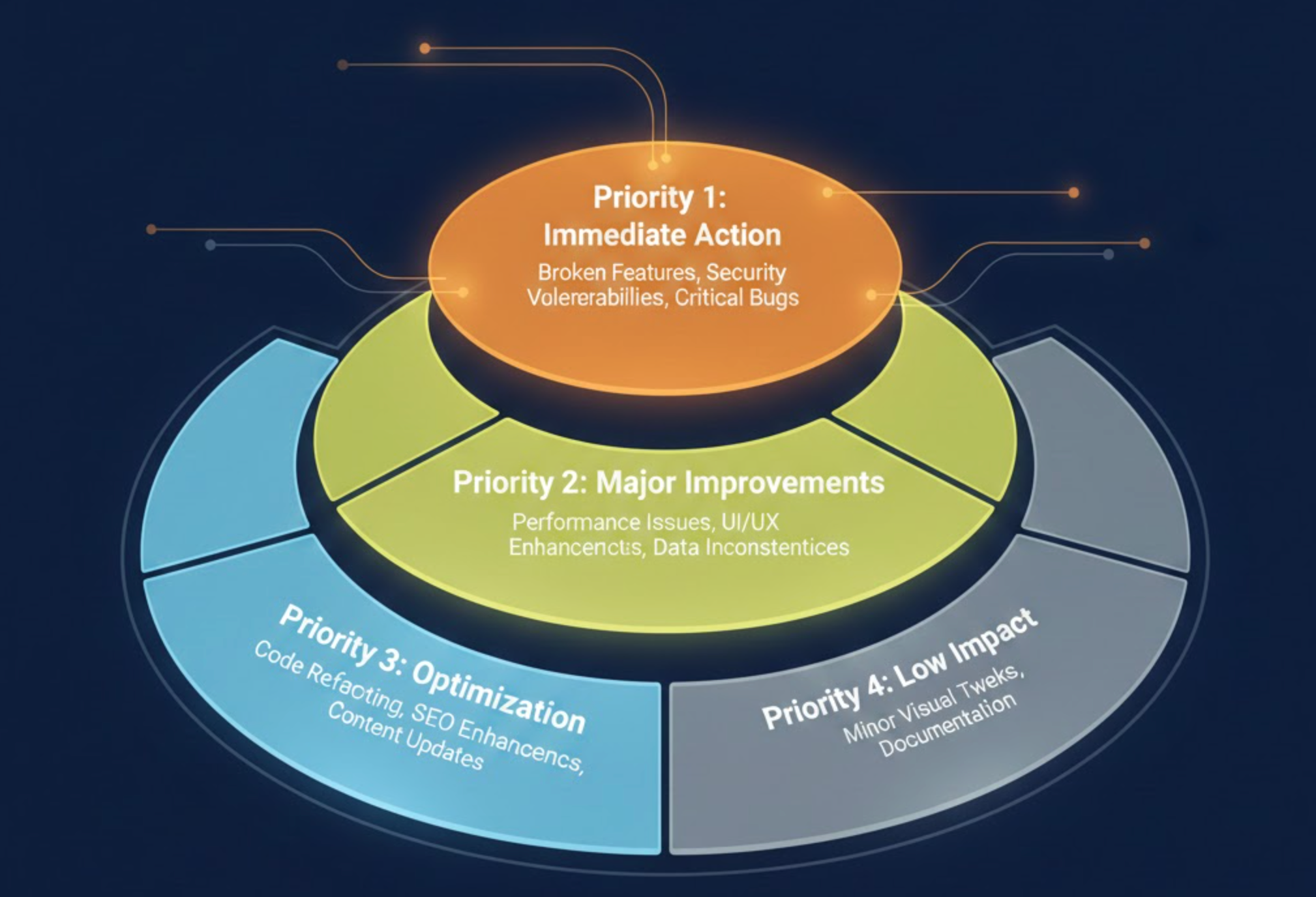
Once your AI audit produces a full list of issues, the next step is to categorize pages by importance. Not every page deserves equal attention; some have immediate SEO potential, while others are low-value and can be deprioritized.
Typical segmentation tiers include:
This structured segmentation gives editors clarity on where to focus first. Instead of jumping around randomly, your team follows a systematic path that maximizes the impact of every hour spent.
With priorities defined, you can move seamlessly into using AI to handle the foundational draft work.
AI is a powerful tool for completing the initial transformation of outdated or weak content. It can take your existing page and generate a more robust, detailed, and logically structured version. This helps elevate the quality baseline before human editors step in.
Examples of what AI can generate:
AI essentially becomes your “first draft machine,” helping you overcome the bottleneck of manual rewriting. After the AI draft is produced, the next stage is adding human refinement to ensure the content meets brand standards and editorial expectations.
With an improved AI-generated draft ready, you can transition into the essential step of manual editing.

While AI accelerates drafting, human editors elevate the content to a publish-ready level. This step ensures that the material reflects real expertise, provides nuanced insight, and avoids generic AI phrasing.
Manual editors focus on:
Human judgment brings depth and authenticity AI cannot replicate. The goal is to transform the AI draft into something aligned with your business strategy and user expectations.
Once the content is refined manually, you can smoothly transition into using AI again, this time for quality assurance and consistency checks.
After manual editing, AI can be reintroduced to perform a second-level cleanup and ensure that all subtle issues are resolved before publication.
AI can assist with:
This stage acts as a safety net. It ensures no human oversight or minor error slips through, making the content polished and consistent across your entire website.
After all automated checks are complete, a human final review ensures the content meets your brand’s highest standards before publication.
Even after AI has completed its checks, a human-only final review is necessary. This ensures nothing compromises quality, trust, or brand authority.
During this last manual pass, editors confirm:
This final review safeguards your brand reputation and ensures your content meets expectations for authenticity and usefulness.
Following publication, your workflow is not finished, you’ll need to refine and improve the system over time through feedback loops.
To maintain long-term efficiency, your AI and editorial workflow should evolve with every cleanup cycle. This means documenting common AI mistakes and teaching editors to adapt prompts, templates, and guidelines.
Examples of feedback loop improvements:
Over time, this feedback loop dramatically improves consistency, reduces editing time, and strengthens your overall workflow.
AI performs best when given extremely clear instructions. A detailed style guide helps AI produce drafts that require far less manual editing.
Your guide should include:
Clear rules lead to better AI-produced drafts, ensuring editors spend more time polishing and less time rewriting.
With a style guideline in place, the next step is building templates to keep your entire cleanup operation consistent.
Templates help maintain consistency across hundreds of pages, especially when working with multiple editors. AI also produces better outputs when working within predefined structures.
Common template types include:
These templates ensure that no matter how many pages you clean up, the structure and quality remain aligned.
With templates ready, batch processing becomes the next efficiency-boosting technique.
Batching makes large-scale cleanup much more manageable and efficient. Instead of addressing every type of issue at once, you focus on one task at a time across multiple pages.
Examples of batch workflows:
Batching reduces context switching, speeds up work, and helps AI generate more consistent outputs.
Finally, after implementation, you need measurable proof that your hybrid workflow is delivering results.
Evaluating performance helps you refine your cleanup strategy and measure improvements over time.
Key metrics include:
Tracking these metrics allows you to see which cleanup activities offer the highest returns, informing future decisions.
AI speeds up the technical and repetitive tasks of content cleanup, while human editors ensure accuracy, depth, and authenticity. When combined, the workflow becomes faster, more scalable, and significantly more effective than relying on AI or human effort alone.
By following a structured process, you create a consistent pipeline that improves content quality sitewide. Over time, this hybrid model becomes a powerful engine for improving SEO, enhancing user trust, and strengthening your brand's online presence.