New to Shopify? Free trial, then $1/month for your first 3 months. Start free trial →
 Where is your store?
Ryviu works with both – pick yours to continue.








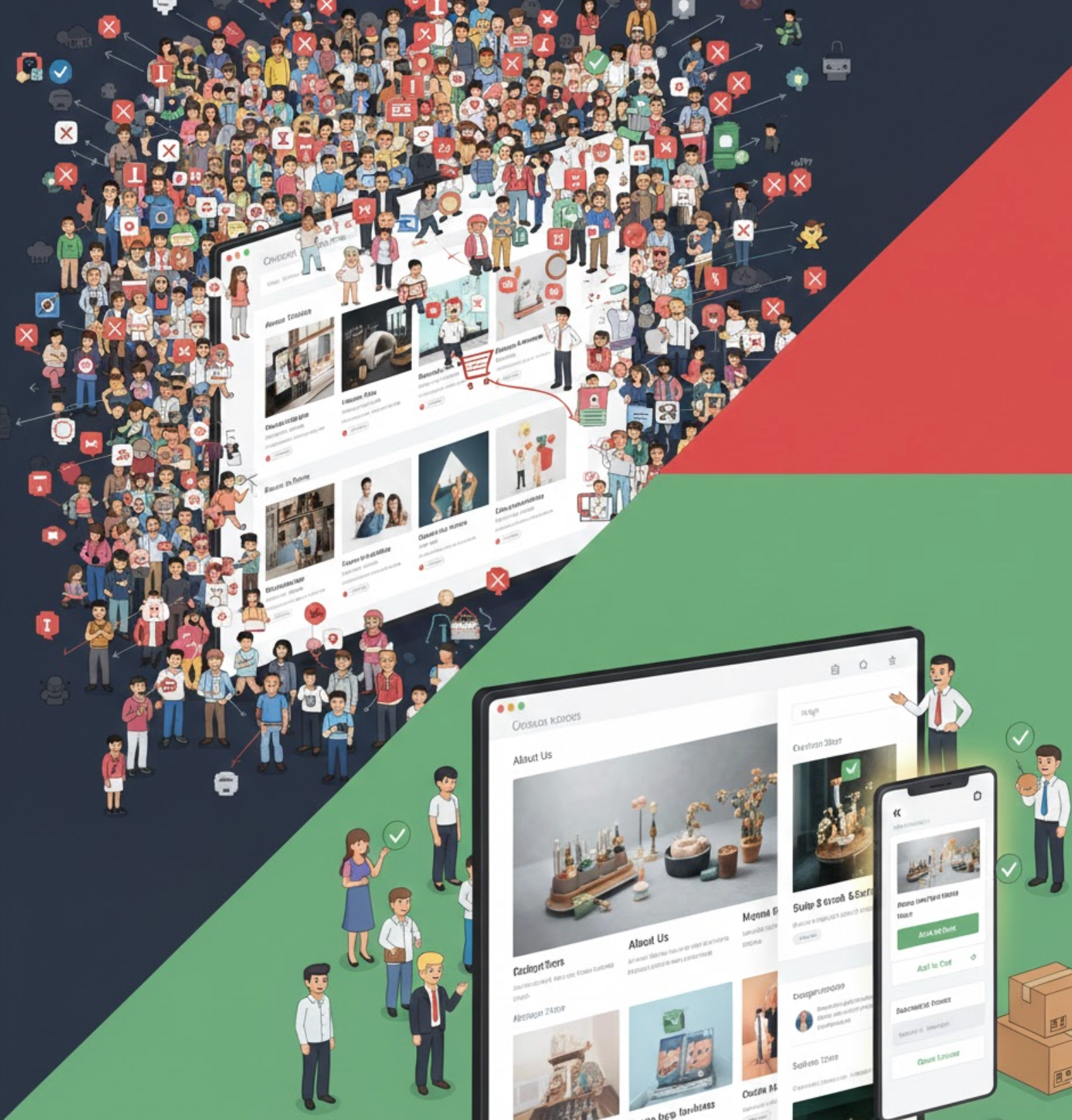
At first glance, high website traffic feels like a success. More visitors should mean more sales, right? In practice, many businesses discover a frustrating reality: traffic keeps increasing, but conversion rates stay flat, or even decline. This gap often leads to wasted ad spend, misleading performance metrics, and stalled revenue growth.
The truth is that traffic is only a potential. Conversion is the result of how well your website meets user expectations, removes friction, and builds confidence. Below are the most common reasons why high traffic fails to turn into high conversion, explained in depth.
Large traffic numbers can look impressive in analytics dashboards, but volume alone doesn’t guarantee results. What truly matters is who is visiting and why they are there.
When traffic is generated through overly broad keywords, viral content, or curiosity-driven social media posts, visitors often arrive without purchase intent. They may be interested in information, entertainment, or inspiration, but not necessarily ready to buy.
Low-quality traffic usually shows these patterns:
In contrast, high-quality traffic comes from users who already understand their problem and are actively looking for a solution. Even smaller traffic volumes with strong intent often outperform massive but unfocused visitor streams.
Even when traffic quality is decent, conversion suffers if the landing page doesn’t clearly match the user’s intent. Visitors arrive with expectations shaped by ads, search results, or social content, and they expect immediate confirmation that they’re in the right place.
When that confirmation is missing, hesitation sets in. Users begin to question whether the product fits their needs, whether pricing is right, or whether they should keep browsing elsewhere.
Common intent mismatches include:
Strong conversion pages reduce friction by instantly aligning message, offer, and value. When users feel understood, they move forward naturally.
Your website’s first impression plays a critical role in conversion. Users subconsciously judge credibility, usability, and professionalism within seconds of landing on a page.
If the layout is cluttered or visually confusing, users struggle to understand what matters most. When everything looks equally important, nothing stands out, and users freeze or leave.
Common design issues that hurt conversion:
Effective visual hierarchy helps users scan, understand, and act without thinking too hard. It turns passive traffic into guided movement toward conversion.
High traffic exposes performance problems faster than anything else. If your site loads slowly or behaves unpredictably, users lose patience before they ever reach checkout.
Modern users expect instant feedback. Every extra second of loading time increases frustration and abandonment, especially on mobile devices, where most traffic now originates.
Technical friction often shows up as:
Traffic may bring users in, but speed and stability determine whether they stay long enough to convert.
Conversion requires trust, and trust must be earned quickly. High traffic does not automatically mean high credibility, especially for newer or lesser-known brands.
When users feel uncertain, they rarely complain or ask questions. They simply leave. This makes trust issues particularly dangerous because they’re invisible in surface-level analytics.
Missing trust elements often include:
Strong trust signals reduce anxiety at critical decision points, making users feel safe enough to move from interest to action.
Offering more options seems helpful, but it often backfires. When users are presented with too many products, variations, or bundles at once, decision-making becomes mentally exhausting.
High traffic magnifies this issue. Each visitor must process large amounts of information quickly, and many decide it’s easier to leave than choose.
Choice overload commonly appears as:
Simplifying choices and guiding users toward “best” or “recommended” options reduces friction and increases conversion.
Many businesses pour resources into traffic acquisition but treat conversion optimization as an afterthought. They assume that if traffic is high enough, sales will follow naturally.
Without intentional optimization, users repeatedly encounter the same barriers—confusing layouts, unclear messaging, or unnecessary steps in the funnel. As a result, increasing traffic only increases the number of people who drop off.
Common optimization gaps include:
Conversion growth comes from continuous refinement, not just more visitors.
High traffic signals interest and visibility, but conversion signals success. Without alignment between traffic quality, user experience, and trust, traffic remains untapped potential.
Businesses that convert well focus on clarity, simplicity, and intent at every stage of the user journey. They don’t just ask, “How do we get more visitors?” They ask, “How do we help the right visitors take the next step?”
When experience matches expectation, traffic stops being just a number, and starts becoming revenue.