New to Shopify? Free trial, then $1/month for your first 3 months. Start free trial →
 Where is your store?
Ryviu works with both – pick yours to continue.









Understanding user behavior is essential for creating experiences that feel intuitive, trustworthy, and conversion-focused. Every click, scroll, and pause tells a story about what users expect and where they struggle. When these actions repeat across many users, they form patterns that reveal powerful insights about decision-making.
Rather than reacting to isolated metrics, identifying patterns helps you see the deeper structure behind user behavior. This allows you to optimize with confidence instead of guesswork. To begin, it’s important to understand what user behavior patterns actually are and why they matter.

User behavior patterns are recurring actions or sequences of actions that users consistently display while interacting with your product, website, or application. These patterns can show up in many forms, such as how users navigate between pages, where they slow down or hesitate, which steps they skip, or which features they return to repeatedly. When the same behaviors appear across a large number of users, they signal shared expectations, motivations, or points of friction in the experience.
These patterns go beyond isolated clicks or single sessions and instead reflect how users naturally think and make decisions. For example, repeated pauses before checkout may suggest uncertainty, while frequent visits to reviews or FAQs often indicate a need for reassurance. By identifying these recurring behaviors, you gain insight into the mental model users apply when interacting with your product.
Recognizing user behavior patterns allows you to shift from reactive fixes to proactive optimization. Rather than guessing why something isn’t working, you can rely on consistent, observable behaviors to guide design and messaging decisions. This approach helps you create experiences that feel intuitive, predictable, and closely aligned with real user intent, ultimately reducing friction and improving overall performance.
Before analyzing any data, you need to clearly define what you want to learn from user behavior. Without focused goals, it’s easy to drown in numbers that look interesting but provide little direction. Clear questions give meaning to the patterns you uncover and keep your analysis aligned with business objectives.
By framing your analysis around specific outcomes, you can better distinguish useful signals from background noise. This ensures that your insights lead to actionable improvements rather than vague observations. Once goals are defined, data analysis becomes more purposeful and efficient.
With clear questions in place, you can begin examining quantitative data for repeating trends.
Quantitative data shows what users do at scale, making it ideal for identifying behavior patterns. Metrics such as bounce rate, time on page, scroll depth, and conversion rates reveal where users consistently engage or disengage. When the same trends appear across pages or segments, they point to structural issues or opportunities.
Rather than focusing on single data points, pattern recognition comes from comparing metrics over time and across contexts. Repetition is what transforms raw numbers into meaningful insights. These trends form the foundation for deeper behavioral analysis.
To understand how users move through your experience step by step, funnel analysis becomes essential.

Funnels map the user journey across a defined sequence of actions, such as browsing, adding to cart, and completing checkout. They help visualize where users progress smoothly and where they consistently drop off. When many users abandon at the same step, a clear behavioral pattern emerges.
These drop-off patterns often indicate friction caused by unclear messaging, unexpected costs, or missing trust signals. Funnels reveal not only where users leave but also when expectations break down. This clarity makes funnels a powerful diagnostic tool.
Beyond step-based analysis, it’s also important to observe how users freely navigate through your site.
Navigation paths and click behavior reveal how users explore your site in real-world conditions. Users often take routes you didn’t anticipate, and repeated detours can indicate unclear structure or missing information. When these behaviors repeat across many users, they form strong usability patterns.
Click behavior also shows what users consider important or confusing. Frequent clicks on non-clickable elements or repeated returns to the same page often signal unmet expectations. These insights help align site structure with user logic.
To better understand why these navigation patterns occur, visual behavior tools provide deeper context.
Heatmaps and session recordings add visual clarity to behavioral data. Heatmaps show where users consistently click, scroll, or ignore content, while recordings reveal hesitation, confusion, and intent. Together, they turn abstract metrics into observable behavior patterns.
When the same interactions appear across many sessions, they indicate a systemic issue or opportunity. These tools help explain why users behave a certain way, not just what they do. This makes them invaluable for experience optimization.
To gain even clearer insights, it’s important to analyze behavior across different user groups.
Not all users behave the same way, and analyzing everyone together can hide meaningful differences. Segmentation allows you to compare behavior across devices, traffic sources, locations, or experience levels. These comparisons often reveal patterns that are invisible in aggregated data.
For example, mobile users may consistently struggle with form completion while desktop users do not. These differences highlight specific optimization opportunities. Segmentation ensures that improvements are tailored rather than generic.
Behavioral data becomes even more powerful when combined with direct user feedback.
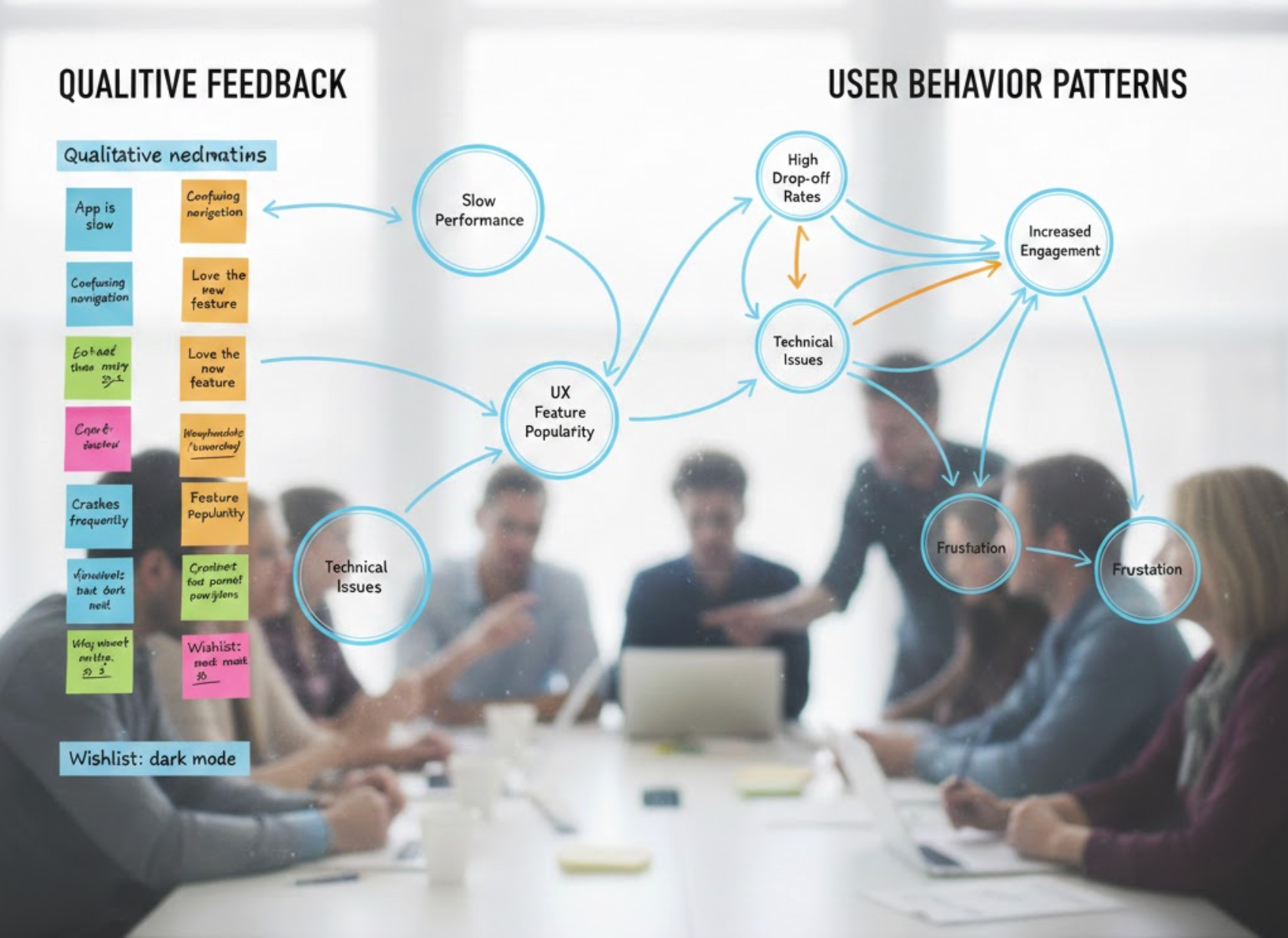
User behavior patterns are also reflected in what users say, not just what they do. Reviews, surveys, interviews, and support tickets often contain repeated themes about confusion, trust, or motivation. When similar feedback appears consistently, it signals a behavioral pattern in perception and decision-making.
Qualitative insights provide emotional and cognitive context to observed actions. They help validate assumptions and explain anomalies in quantitative data. Together, these insights create a more complete understanding of user behavior.
To ensure accuracy, identified patterns should be observed consistently over time.
Not every trend is a true pattern, and acting too quickly can lead to incorrect conclusions. Valid patterns persist across time periods, traffic changes, and experiments. Observing behavior consistently helps separate long-term insights from temporary fluctuations.
Validation ensures that decisions are based on stable user behavior rather than short-lived events. This reduces risk and increases confidence in optimization efforts. Only confirmed patterns should guide significant changes.
Once validated, these patterns can be transformed into practical improvements.

Identifying patterns is only valuable when it leads to meaningful action. Each pattern should be translated into a clear insight that explains a user's need, hesitation, or motivation. These insights then guide design, messaging, or experience improvements.
Actionable insights help teams prioritize changes that have the greatest impact. They turn observation into strategy and data into direction. Over time, this creates a more intuitive and conversion-friendly experience.
Ultimately, pattern-based decisions lead to experiences that feel designed for users, not assumptions.
Identifying patterns in user behavior allows you to understand the logic behind user decisions, not just the outcomes. By combining quantitative data, qualitative feedback, segmentation, and validation, you gain a holistic view of how users interact with your product. This approach replaces guesswork with insight-driven optimization.
When you focus on recurring behaviors instead of isolated metrics, your improvements become more intentional and effective. Over time, this leads to smoother journeys, stronger trust, and higher conversions. Pattern recognition turns user behavior into a powerful strategic advantage.