New to Shopify? Free trial, then $1/month for your first 3 months. Start free trial →
 Where is your store?
Ryviu works with both – pick yours to continue.








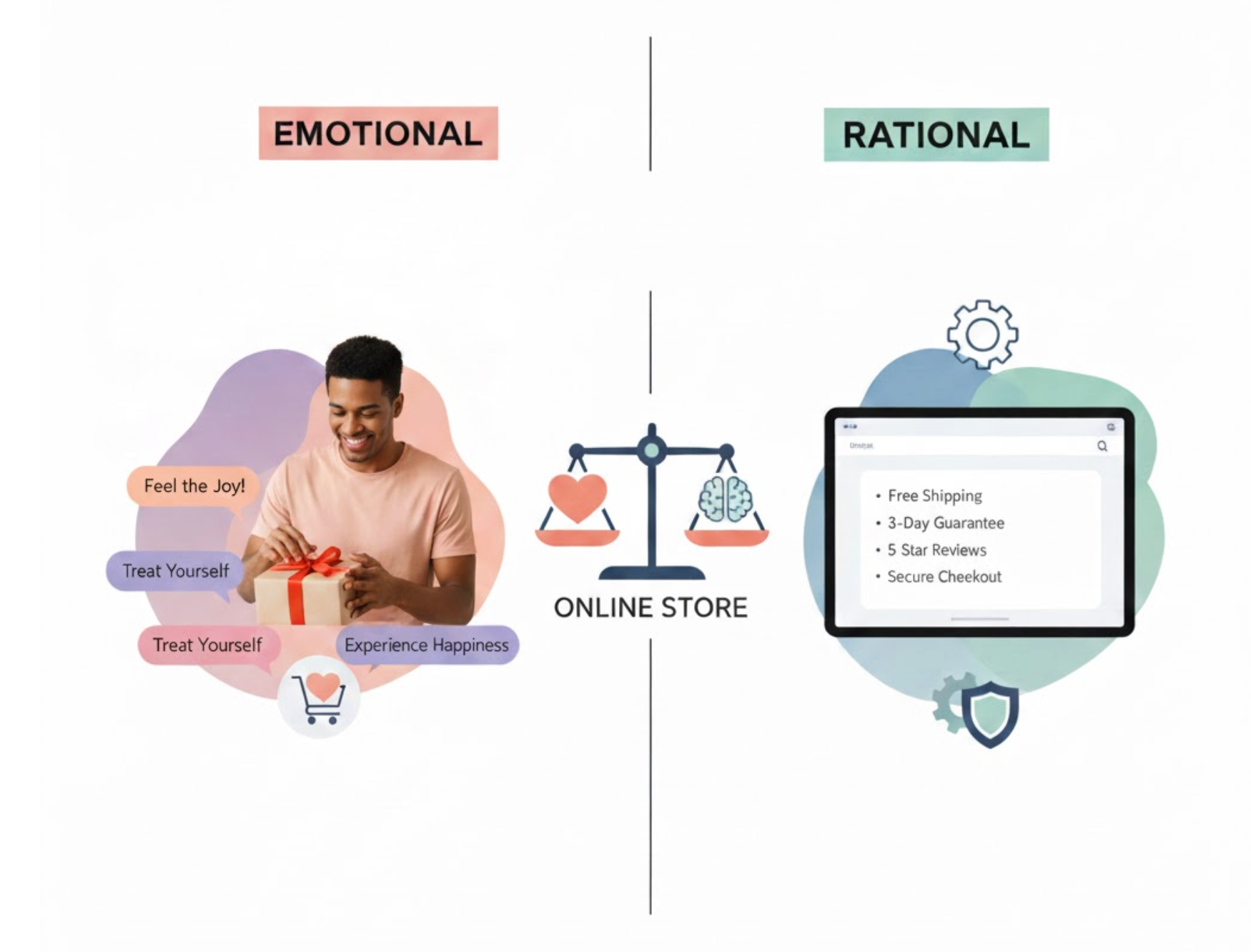
Marketing success rarely comes from simply having a great product. More often, it depends on how clearly and convincingly that product is communicated. Many brands struggle not because their offering lacks value, but because their messaging leans too heavily in one direction. Some rely almost entirely on emotional storytelling, hoping inspiration alone will drive conversions. Others focus purely on facts, features, and numbers, assuming logic will be enough to persuade buyers.
In reality, customers do not make decisions in such a one-dimensional way. Most purchasing decisions begin with emotion and are later justified with logic. People react first, then reflect. This is why balancing emotional and rational messaging is one of the most important skills in modern marketing.
When emotional appeal and rational proof work together, your message becomes both engaging and trustworthy. Emotion draws people in, while logic gives them permission to move forward. Understanding how to blend these two forces is key to creating marketing that converts without overpromising or overwhelming.
Emotional messaging focuses on human feelings, motivations, and personal meaning. It speaks to how a product fits into someone’s life rather than what it technically does. At its core, emotional messaging answers a simple but powerful question: Why does this matter to me?
Emotion is often the first trigger in any buying journey. Before customers analyze features or compare prices, they react instinctively. They imagine outcomes, frustrations, relief, or improvement. Emotional messaging taps into these reactions and creates a personal connection between the audience and the product.
To understand emotional messaging more clearly, it helps to look at the emotional triggers that most commonly influence buying behavior across industries and audiences.
Common emotional drivers in marketing
While emotional messaging is powerful for capturing attention, it is rarely enough on its own. To move customers forward, it must be reinforced with clear, rational support.
Rational messaging appeals to logic, evaluation, and conscious decision-making. It focuses on facts, clarity, and evidence. While emotion may spark interest, rational messaging answers the next critical question: Is this the right choice for me?
Once customers feel drawn to a product, they naturally begin to analyze it more carefully. They compare alternatives, look for proof, and evaluate whether the product justifies its price. Rational messaging supports this phase by providing the information customers need to feel confident and informed.
At this stage, buyers typically look for specific types of information that help them reduce uncertainty and validate their decision.
Common rational elements in marketing
As customers move closer to conversion, rational messaging becomes increasingly important. Without it, even strong emotional interest can turn into hesitation.
Today’s buyers are more informed, more skeptical, and more selective than ever before. They are exposed to countless marketing messages every day, which makes them quick to feel intrigued but equally quick to question claims. This environment makes balance between emotional and rational messaging essential.
When messaging leans too heavily toward emotion, it may generate interest but fail to build trust. Conversely, when messaging focuses only on logic, it may inform without inspiring action.
When emotional messaging overwhelms the rational side, several issues often emerge:
On the other hand, overcorrecting toward logic creates a different set of problems.
A well-balanced message avoids both extremes. Emotion captures attention, while logic builds confidence and credibility.
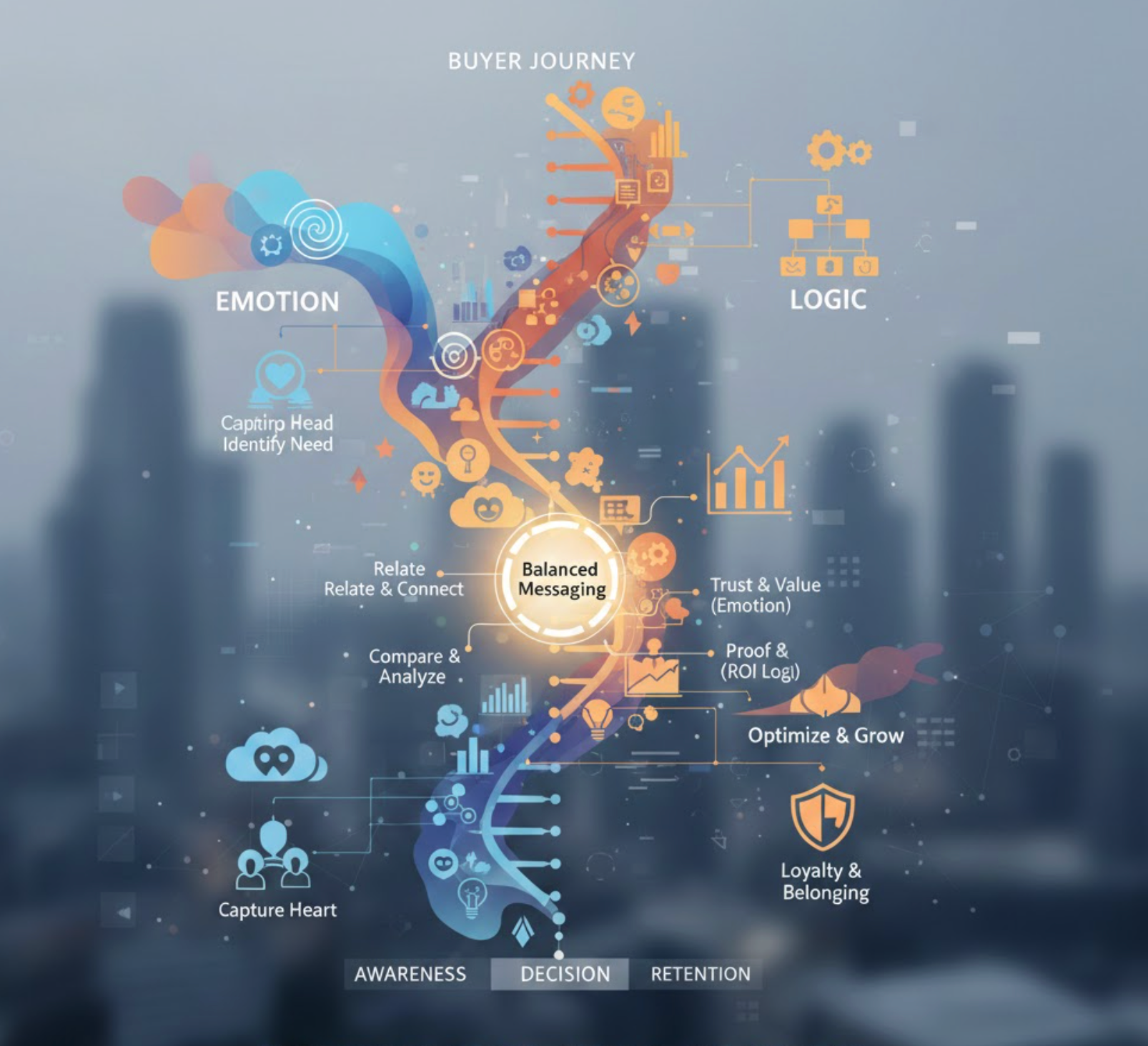
Not every stage of the buyer journey requires the same type of messaging. Understanding when to emphasize emotion and when to emphasize logic helps ensure customers receive the right information at the right time.
At the awareness stage, customers are just beginning to recognize a problem or opportunity. They are not yet comparing tools or analyzing features in detail.
At this point, messaging should focus on connection rather than explanation.
Rational details can exist quietly in the background, but emotion should lead the experience.
As customers start evaluating solutions, they need inspiration and information working together.
Messaging at this stage should clearly connect feelings with facts.
This is where balance matters most, as customers are actively deciding whether to move forward or look elsewhere.
When customers are ready to make a choice, reassurance becomes the priority.
At this stage, logic should take the lead while emotion reinforces confidence.
Here, emotion should reassure rather than excite.
True balance does not come from separating emotion and logic into different sections. The strongest messaging blends both naturally within the same narrative.
One effective approach is to guide the customer through a familiar mental process.

Most people respond best when they feel understood before being informed.
This structure aligns closely with natural decision-making.
Features alone rarely persuade. Their value comes from what they enable customers to achieve.
To make features more compelling, they should always be tied back to personal benefits.
This ensures logic never feels detached from relevance.

Strong emotional claims require credible reinforcement.
Without proof, even well-written messaging can feel hollow.
Proof transforms emotion from persuasion into reassurance.
Even with the right structure, messaging can fall apart if the tone feels off. Language choices play a critical role in maintaining balance. Exaggerated language often creates skepticism instead of excitement.
To keep emotion effective, it should feel grounded and sincere.
Emotion works best when it feels authentic.
Logic does not require complexity.
When language becomes too technical, it creates distance instead of trust.
Clear language builds confidence without intimidation.
Different marketing channels naturally emphasize different strengths. The goal is not to use the same message everywhere, but to maintain consistency in balance.
Landing pages should guide visitors smoothly from interest to action.
Product pages should deepen understanding while reinforcing desire.
Email allows for a more personal balance of emotion and logic.
Short-form content must work quickly.
There is no single formula for perfect balance. Audience expectations, product complexity, and price all influence what works best.
Because of this, ongoing testing is essential. Follow the ways below to test and refine your messaging:
Over time, these insights reveal whether your audience needs more inspiration or more reassurance.
Even experienced teams struggle to maintain balance. Being aware of common pitfalls makes it easier to refine messaging over time.
Some mistakes appear repeatedly across industries and formats.
Avoiding these mistakes helps maintain clarity, trust, and engagement.
Balancing emotional and rational messaging is not about compromise. It is about alignment. Emotion gives your message meaning, while logic gives it credibility. One captures attention, the other earns trust.
When both work together, customers feel understood and informed at the same time. They are not pushed into decisions, but guided toward confidence.
The strongest marketing does not force customers to choose between feeling and thinking. It respects both, weaving them into a message that feels honest, clear, and persuasive.