New to Shopify? Free trial, then $1/month for your first 3 months. Start free trial →
 Where is your store?
Ryviu works with both – pick yours to continue.








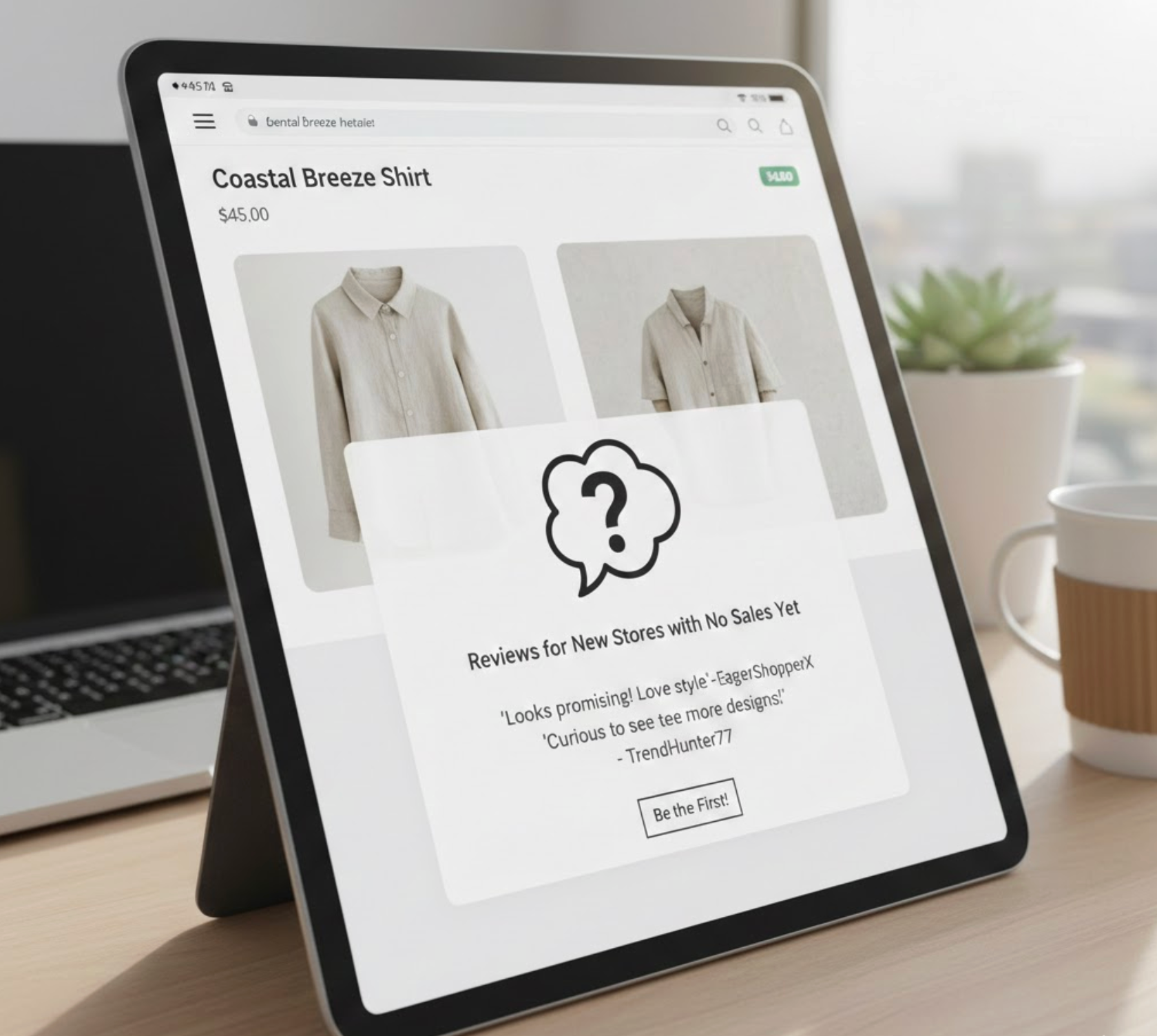
Launching a new online store is an exciting milestone, but it is also one of the most fragile stages of the eCommerce journey. Even with strong products, competitive pricing, and a professional-looking website, most first-time visitors will hesitate to place an order if they feel uncertain. At this early stage, the biggest challenge is rarely traffic or visibility, it is trust.
In eCommerce, trust is often built through social proof, and reviews are one of the most visible and influential forms of it. However, new stores face a difficult paradox: customers want reviews before they buy, but reviews only appear after customers buy. Understanding how to approach reviews strategically, ethically, and transparently is essential for breaking this cycle and building early momentum.
This article outlines best practices for managing reviews when your store has no sales, helping you move from zero social proof to a solid foundation for long-term growth.
For established brands, reviews act as reinforcement. Customers already recognize the brand name, understand its reputation, and feel a certain level of confidence before they even reach the product page. Reviews in this case simply validate what shoppers already believe. However, for new stores, the situation is very different. Reviews do not reinforce trust—they create it from the ground up.
When a shopper lands on an unfamiliar store, they immediately begin assessing risk. Without brand recognition, past experience, or word-of-mouth recommendations, customers rely heavily on visible trust signals to decide whether it is safe to proceed. Reviews become one of the first elements they look for, often before reading detailed product descriptions or checking policies. In this context, reviews serve as a shortcut for trust, helping customers quickly answer the question: “Can I trust this store?”
From a psychological perspective, reviews reduce uncertainty by showing that other people have already taken the same risk and survived it. They reassure potential buyers in several key ways:
What is especially important for new stores is that no reviews often feel more dangerous than imperfect reviews. A product with mixed but genuine feedback still feels tested and real, while a product with no reviews at all can feel unproven or risky. This is why even a small number of authentic reviews can dramatically shift perception, turning hesitation into confidence and significantly improving conversion rates during the earliest stages of a store’s growth.
Many new merchants assume that appearing “new” will discourage customers. While this can be true if handled poorly, transparency often has the opposite effect when combined with professionalism and clear communication.
Rather than trying to appear larger or more established than you are, it is often more effective to clearly explain your position and intentions:
When customers understand who you are and why you exist, they are more likely to give a new brand a chance, especially if expectations are set honestly from the beginning.
Even if your store has no direct sales yet, you may still have access to legitimate product-related feedback, depending on how your business operates. The key is not just whether you use these reviews, but how clearly you present their context.
In many cases, products have already been tested or purchased before a public launch. These early interactions provide valuable insights and should not be wasted.
You can responsibly showcase this feedback by:
By explaining where these reviews come from, you allow customers to evaluate them with the right expectations, which preserves trust.
For products that already exist in the market, customers often want reassurance about the product itself before they evaluate the store behind it.
In this situation, product-level reviews can help clarify quality and usability when handled correctly:
When transparency is maintained, these reviews help customers make informed decisions without misleading them. When you sell dropshipping items from marketplaces like Aliexpress or Amazon, you can import reviews from these sources to your store to build trust faster.

Before investing heavily in advertising or scaling traffic, many successful stores focus on gathering feedback through early testing or soft launches. This controlled approach allows you to improve your store while collecting meaningful reviews.
Early testing is effective because it creates a low-pressure environment where feedback is more thoughtful and detailed:
These early reviews often feel more authentic than mass-market feedback and help establish a trustworthy starting point for your store.
Incentives can be useful, but only when they are structured to encourage participation, not bias. The goal is to motivate customers to share their experience, not to influence what they say.
A fair incentive approach typically includes:
When customers know their opinions are valued, reviews feel more credible and trustworthy to future shoppers.
When reviews are limited, customers naturally look for other signals to assess whether your store is legitimate. This makes the overall shopping experience just as important as social proof.
To compensate for limited reviews, your store should clearly communicate reliability through multiple touchpoints:
Together, these elements reduce uncertainty and help customers feel comfortable buying from a new store.
Once your first orders come in, review collection should move from an occasional task to a consistent process. Early reviews matter most, so timing and simplicity are critical.
A well-structured system usually involves:
Using a review app that supports automation can make this process much easier. For example, Ryviu helps Shopify merchants collect and display authentic product reviews in a structured and transparent way, allowing new stores to start building social proof immediately without complex technical setup.
Fake reviews may seem tempting during the early stages, but they undermine everything you are trying to build. Beyond violating platform policies, fake reviews permanently damage trust if discovered.
Customers are increasingly good at recognizing warning signs, such as:
In contrast, real reviews, especially those that mention both strengths and limitations, feel far more believable and persuasive.
Early reviews should not simply sit on your product pages. When used strategically, they provide insights that help your store grow stronger over time.
You can actively leverage early feedback by:
This feedback loop turns reviews into both a trust signal and a source of continuous improvement.
For new stores with no sales, reviews are not an impossible barrier, they are a process. By focusing on transparency, ethical review collection, strong trust signals, and structured systems, new stores can overcome early skepticism and build credibility step by step.
When handled correctly, early reviews do more than increase conversions. They help define your brand, guide improvement, and create the trust needed for sustainable, long-term eCommerce growth.